Paper choice is the difference between "this is relaxing" and "why did my marker soak through to the next page?"
This guide tells you what to buy in plain terms, why it works, and how to avoid the two most common mistakes: picking paper your printer can't feed, and picking paper that fights your coloring tool.
The three best papers for most people
If you just want the short version:
- Best all-around (pencils and light markers): 32 lb premium printer paper (around 120 GSM)
- Best for colored pencil layering and blending: Bristol vellum (often 160 to 200 GSM)
- Best for alcohol markers: marker paper (bleed-resistant) or smooth heavyweight cardstock, single-sided
If you don't know what you'll use, start with 32 lb premium. It's the best upgrade from standard 20 lb without causing printer jams.
The basics: weight, finish, and tooth
Paper weight (lb and GSM)
You'll see paper sold as:
- lb (pounds) in the US (usually "basis weight")
- GSM internationally (grams per square meter)
You don't need perfect conversions. Think in ranges:
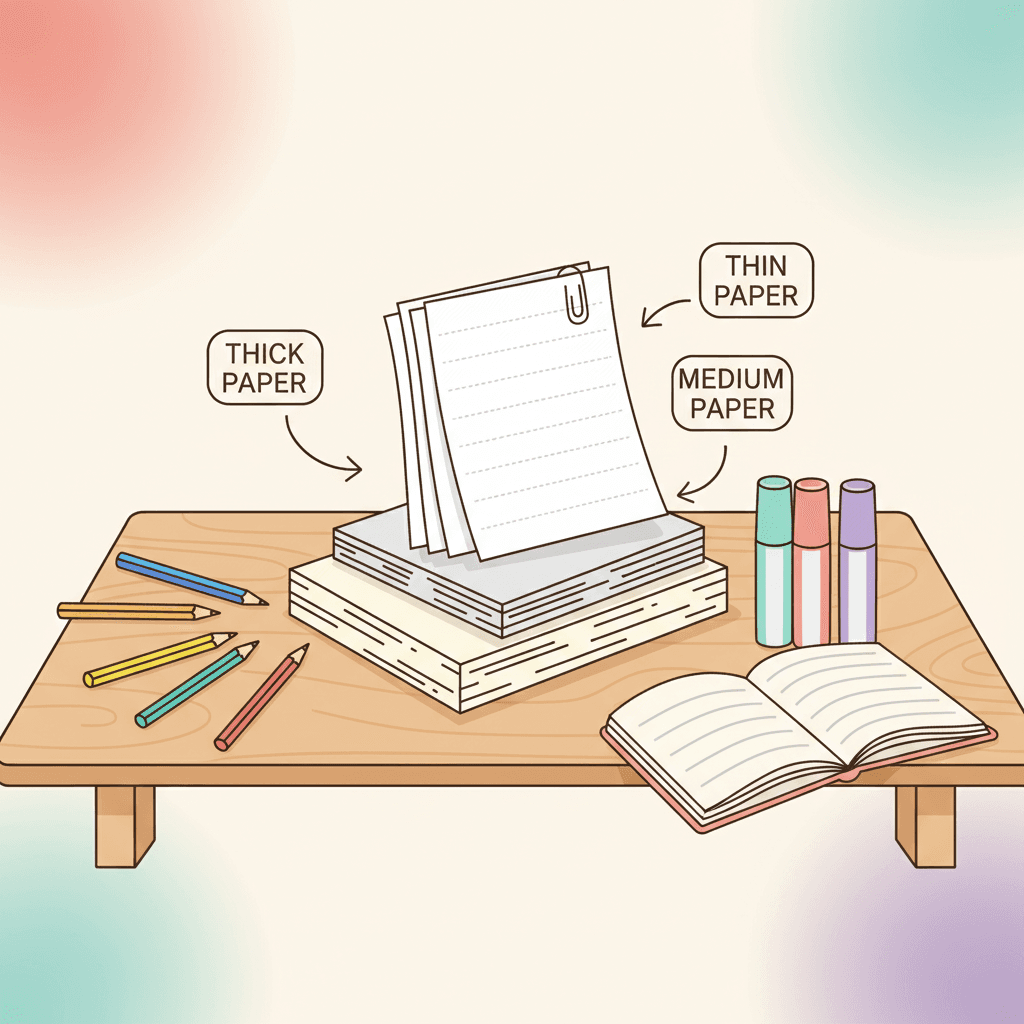
- 20 to 24 lb: standard printer paper. Easy printing, fine for crayons and pencils.
- 28 to 32 lb: premium printer paper. Better for pencils, less bleed, nicer feel.
- 60 to 80 lb cover / 160 to 216 GSM: cardstock and Bristol territory. Stiffer, better for wet media, harder on some printers.
Finish: smooth vs vellum (textured)
- Smooth: best for crisp marker fills and clean linework. Pencils can look slick unless you layer carefully.
- Vellum or textured ("tooth"): grips colored pencil pigment and supports more layers. Markers may feather slightly on rough surfaces.
Brightness
For line art, brighter paper often makes lines look sharper. If you scan or photograph finished pages, a bright white also makes editing easier.
Choose paper by what you color with
Colored pencils (especially adult coloring and blending)
What you want: a little tooth so pigment builds in layers, and enough weight that repeated layering doesn't pill the surface.
Best picks: Bristol vellum, colored-pencil specific paper, or premium 32 lb printer paper as a budget option.
Avoid: ultra-smooth, shiny paper for heavy layering. It can resist pigment and look streaky.
Crayons (kids and classrooms)
Crayons are forgiving. Standard 20 to 24 lb works. Bump to 28 lb if you want less wrinkling and a nicer feel.
Gel pens
Gel pens can show through thin paper, and heavy "scribble fills" can warp lightweight sheets. Go with 28 to 32 lb premium, or smooth cardstock if you press hard.
Water-based markers
These can still bleed, especially on saturating strokes. Use 32 lb premium for light use, or cardstock for heavier fills.
Alcohol markers (Ohuhu, Copic-style)
Alcohol markers tend to bleed through most papers. Your goal is managing that.
Best picks: marker paper (bleed-resistant, often designed for alcohol ink) or heavy smooth cardstock, single-sided.
Must-do habit: always put a blotter sheet behind your page.
For the science behind bleed-through and how to fix it, see Marker bleed through paper: why it happens and how to prevent it.
Printer compatibility (the part most guides skip)
Step 1: find your printer's paper weight limit
Look for your model's spec sheet and find:
- Max paper weight (often listed in GSM)
- Whether max weight differs for rear feed vs cassette
In general, rear feed handles thicker paper better, and auto duplex (two-sided printing) often supports thinner paper than single-sided.
Step 2: run a quick "thick paper" test
- Load one sheet of your thickest paper.
- Print a simple page.
- If it feeds cleanly, try 3 to 5 sheets.
Stop immediately if you hear roller slipping or see skewed feeding. Don't force it.
The decision tree (pick your paper in 30 seconds)
Are you using alcohol markers? Yes: marker paper or smooth heavy cardstock, single-sided.
Are you doing colored pencil blending or burnishing? Yes: Bristol vellum or colored-pencil paper. 32 lb premium as a backup.
Is this for kids or bulk classroom printing? Yes: 20 to 24 lb standard (or 28 lb if budget allows).
None of the above? Go with 32 lb premium.
Cheat sheet
| Tool | Best paper type | Weight | Notes |
|---|---|---|---|
| Crayons | Standard printer paper | Light | Cheapest, prints easily |
| Colored pencils (layering) | Bristol vellum or pencil paper | Medium-heavy | Holds layers, better blending |
| Gel pens | Premium printer paper | Medium | Less show-through than 20 lb |
| Water-based markers | Premium or cardstock | Medium-heavy | Still use a blotter sheet |
| Alcohol markers | Marker paper or cardstock | Heavy | Expect bleed on normal paper |
Watch: paper and pencil techniques
See also: Paper thickness discussion on TikTok
Further reading
- 6 paper choices for printing coloring pages at home (Artistry by Lisa Marie)
- Best paper for printing coloring pages (SketchJoy)
- Paper recommendations from Coloring Bliss
FAQ
Is cardstock always better?
Not always. Cardstock is great for markers, but it can jam some printers and be unpleasant for colored pencil blending if it's too slick.
What if I want to print double-sided?
Double-sided is usually fine for pencils and crayons, but risky for markers and gel pens. If you do duplex printing, test for show-through first.
What's the best "one paper" if I'm not sure?
32 lb premium printer paper. It's the best default for most households.
Want to get the print settings right too? See How to print coloring pages, or browse coloring pages to try your new paper on.