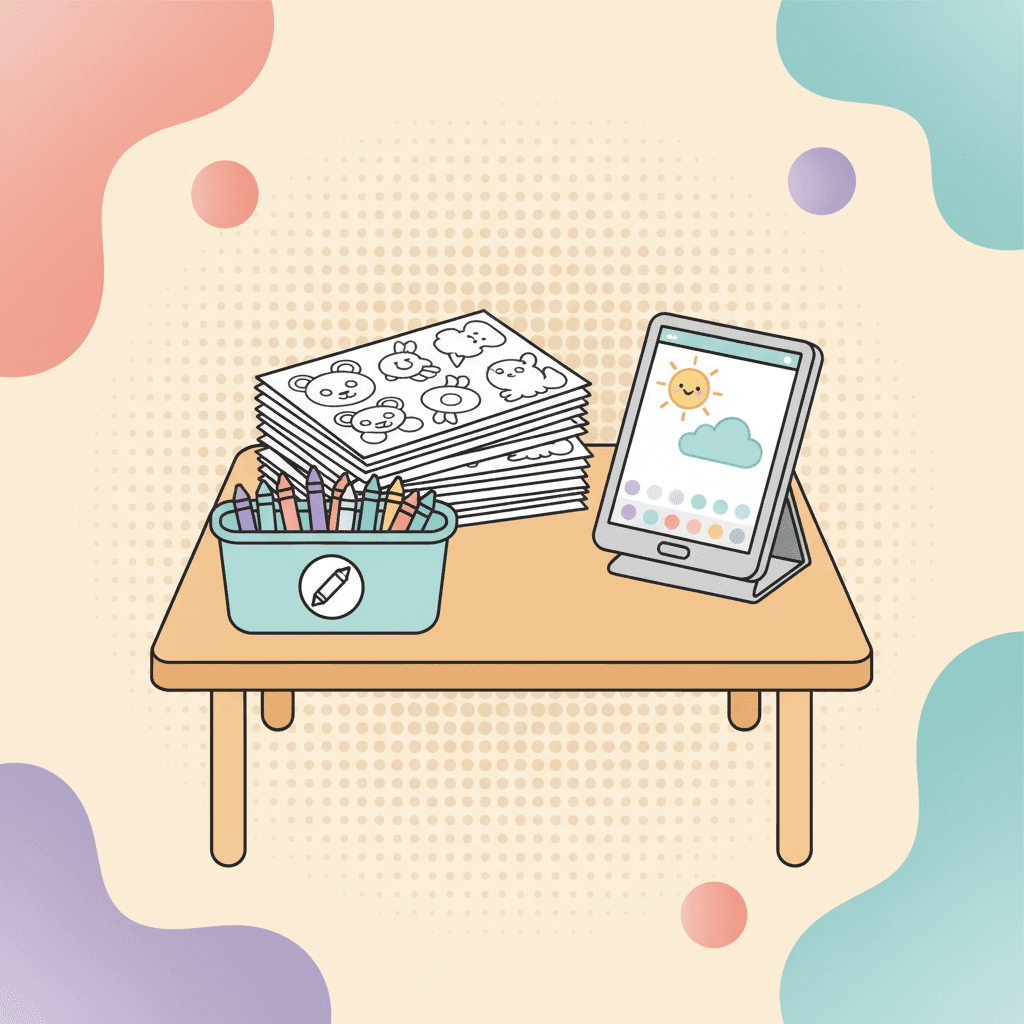
Coloring can be just a fun activity, but in kindergarten it can also be a surprisingly useful classroom tool. It supports fine motor control, reinforces routines and independence, and fills transition time without chaos.
The key is structure. Coloring works best when it's not a free-for-all.
The three best coloring activity formats
If you only pick three, pick these:
- Early finisher bin (self-serve, quiet, predictable)
- Color-by-code or color-by-number (structured, fewer arguments)
- Calm-down corner pages (simple, soothing themes)
Classroom setup: what makes coloring actually run smoothly
The "one bin" rule
Keep coloring materials in one place: pages, pencils or crayons, a few backup sharpened pencils, and a clear "done" tray.
Use a timer every time
Kindergarten works best when "start" and "stop" are predictable. Try 6 to 8 minutes for transitions (arrival, after recess), 10 to 12 minutes for centers, and 15 minutes for calm-down or early finisher blocks.
Say it the same way every time: "Color until the timer beeps. Then we put it in the done tray."
Two rules that prevent most problems
- Color on your paper only.
- One tool at a time (or "crayons only" for this station).
Optional third rule if you need it: "No arguing about colors."
15 kindergarten coloring activities (organized by purpose)
Early finisher coloring (quiet independence)
Goal: buy time without noise.
Setup: a labeled bin ("Early Finisher Coloring"), a "take 1 page" rule, and a "done tray" rule. Pages that work best: familiar themes (animals, food, nature) with medium-simple designs, not tiny regions.
Calm-down corner coloring (self-regulation)
Goal: help students settle in a calm, supportive way.
Keep a small set of calming pages only. Fewer choices work better here because too many options can increase dysregulation. Teacher script: "We're doing one page and one timer. Then we decide what's next."
Roll-and-color (math and color practice)
Materials: one die and a simple roll-and-color key. Variations: roll for 1 to 6 colors, or roll and count objects before coloring.
Color-by-code or color-by-number (structure)
Reduces decision fatigue and arguments. Especially good on high-energy days or when you have a substitute.
"Find and color" (visual scanning)
Prompts like "Find 5 triangles and color them blue" or "Find all stars and color them yellow." Great for building attention and shape recognition.
Letter-of-the-week coloring (literacy)
Use prompts like "Circle and color all the A's" or "Color only pictures that start with /m/."
Name practice coloring (ownership and fine motor)
Print student names in large bubble letters. Students trace, color, and decorate. They love anything with their name on it.
Sight word highlight and color (two-step attention)
Step 1: highlight the target word. Step 2: color a picture after the highlight is complete. Keeps the sequencing clear.
"Color the biggest shapes first" (executive function)
A simple prompt that reduces overwhelm on detailed pages. It teaches kids to scan and plan before starting.
"One color family" challenge (calm and creativity)
Prompts like "Use only warm colors" or "Use only blues and greens." Limits choices in a way that feels like a game.
Storytime follow-up coloring (comprehension)
After a read-aloud: "Color the character," "Color the setting," or "Color one thing that happened." Connects the story to a hands-on task.
Partner coloring (social skills)
One page between two students. Each student colors one section at a time. Use short timers to keep things moving and prevent conflict.
"Color then write" (writing warm-up)
Color for 6 minutes, then write one sentence about the picture or one label word. Good for reluctant writers who need a warm-up.
Fine-motor focus pages (pencil control)
Use pages that emphasize small circles, tracing outlines, and controlled fills. Less about the picture, more about the hand practice.
Sub plans and emergency coloring folder
Keep 10 pages, 1 instruction sheet, and a clear "done" routine ready to go. When the substitute needs something that works with zero prep, this is it.
Differentiation (easy, medium, challenge)
Instead of giving everyone the same page, keep three stacks:
- Easy: big shapes, thick lines, lots of open space.
- Medium: moderate detail.
- Challenge: more detail for fast finishers.
This cuts frustration for students who struggle and boredom for students who need more.
Supplies: what to stock
Best defaults: crayons (most forgiving), standard colored pencils, and a small set of markers only if you have routines for them.
If you use markers: put a blotter sheet behind pages and print on thicker paper when possible. More on that at Marker bleed through paper and Best paper for printing coloring pages.
Accommodation-friendly tweaks
For students who struggle with fine motor: offer thicker crayons or pencil grips, use easier pages with bigger shapes, and allow partial completion ("color 3 big shapes").
For sensory needs: keep the station calm and consistent, and reduce the number of choices.
See it in action
Further reading
- Color activities for kindergarten (Mrs. Wills Kindergarten)
- Free coloring pages for kids (Crayola)
- Kindergarten color worksheets (K5 Learning)
FAQ
How long should kindergarteners color?
For most classes, 6 to 12 minutes works best. Longer blocks can be great, but only if your routines are strong.
What's the best way to stop arguing about colors?
Use structured prompts ("warm colors only") or color-by-code pages. Fewer choices means fewer conflicts.
Browse kid-friendly coloring pages to stock your classroom bins.