Most quiet time advice assumes you have a kid who will play independently in their room for 45 minutes. Sites like The Mom Hour's quiet time guide are right that you build up to that slowly, with short sessions and visual timers. But some days you don't need an hour of independence training. You need ten minutes, right now, that start clean and end without drama.
This is the ten-minute version we actually run at home: one page, one timer, one stop rule. I've used it in the 4pm witching hour, during a work call I couldn't move, and on the third rainy day in a row. The first week was rocky. By week three my kids started the routine themselves when they heard the timer app chime, which is the closest thing to magic I've found in parenting.
Why 10 minutes and not 30
Ten minutes sounds too short to bother with. It isn't, for three reasons:
- Kids can actually finish it. A session that ends while focus is still intact teaches "coloring time ends fine." A session that ends in boredom or a meltdown teaches the opposite.
- You can repeat it daily. A 30-minute block needs planning. A 10-minute block fits after lunch, before dinner, or between errands, and repetition is what turns an activity into a routine.
- Short sessions still do the calming work. The research on coloring mostly tested 10 to 20 minute sessions, not hour-long ones. Ten focused minutes is the tested dose, not a compromise.
If your kid settles deeply and you have the time, let it run longer. But design the routine for ten so it survives your worst days.
Pick the right page first
The page choice decides whether your kid settles in or bounces off in 30 seconds. Match region size to age, then let the theme be their choice:
| Age | What works | A real example to start with |
|---|---|---|
| 3 to 5 | One big subject, few regions | The happy elephant or watermelon smile |
| 6 to 8 | A simple scene with a handful of objects | The rocket launch or fire truck |
| 9+ | More detail, smaller regions, patterns | The city skyline or dragon treasure |
Here's what those picks actually look like, so you can eyeball the difficulty jump between age bands:






Theme-first beats skill-first. A kid who loves rockets will work harder on a rocket page than on a "developmentally appropriate" page they didn't choose. Browse Animals, Vehicles, Dinosaurs, or Space and let them pick inside the theme.
If picking turns into browsing and browsing turns into stalling, remove the choice for one session with a random coloring page. One reroll allowed, then the timer starts. When picks keep missing, go simpler than you think; the easy pages are the reliable tier.
Do a 60-second setup
Treat the first minute like a launch sequence, the same every time:
- Open the page and go full screen.
- Set the tablet on a table, not a couch cushion. Wobbly tablets make wobbly attention.
- One tool only: finger or stylus, not a choice between them.
- Say the rule in one sentence: "Color until the timer beeps; then we save and stop."
A visual timer helps enormously for kids under six, because "ten minutes" means nothing to them but a shrinking countdown does. We use a plain kitchen timer now, but a countdown video on a second screen worked well in the beginning. This one pairs a 10-minute countdown with calm music, which doubles as a volume level for the room:
Make the environment boring on purpose
Quiet time is not the moment for extra choices. You want the setup to feel identical every day:
- Same spot at the table. If you run this for siblings, assign seats before you open a page; a fixed spot prevents the slow drift into elbow wars.
- Loud toys out of sight, not just out of reach.
- Snacks and drinks somewhere else. One spilled cup ends the routine faster than any tantrum.
Boring is the point. Novelty is the enemy of a routine that starts itself.
Run the 10-minute loop
Minute 0 to 1: start. Timer on. Ask exactly one choice question: "Background first or character first?" One question gives a sense of control; three questions reopen negotiations.
Minutes 1 to 8: settle. Give one focus prompt, then stop talking. The prompts that work in our house:
- "Fill the biggest shapes first."
- "Pick three colors and reuse them."
- "Make the sky a gradient."
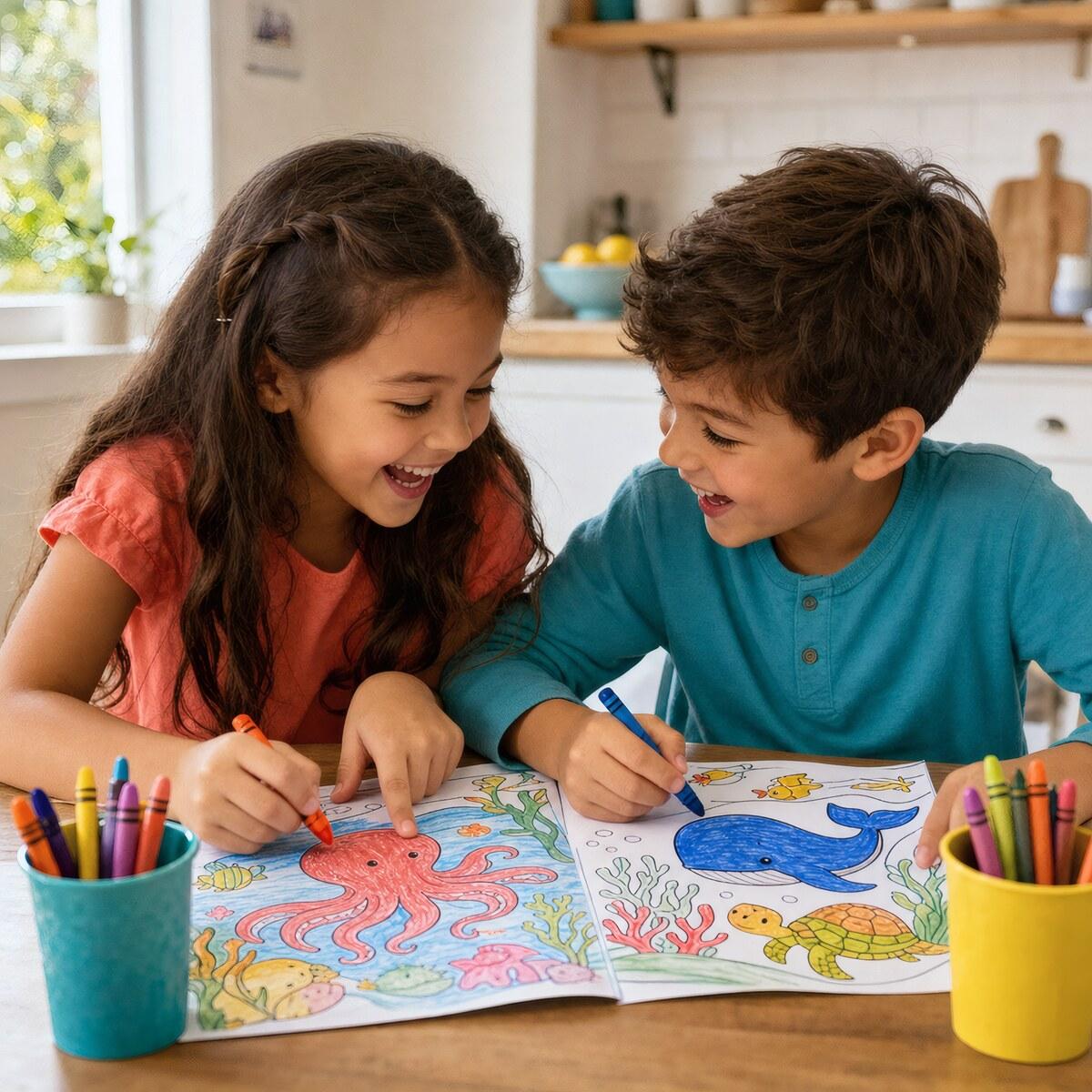
Resist narrating their work. Every comment, even praise, pulls them out of the settled state you're trying to build. If you have siblings coloring at once, give each kid a different goal; identical goals invite copying accusations.
Minutes 8 to 10: land the plane. At the two-minute mark, say "pick one last spot to finish." When the timer beeps: save, then name the picture. Naming sounds trivial, but it turned our hardest stopper into an easy one, because a named picture feels finished even when it isn't fully colored.
End without a meltdown
Quiet time fails when the stop feels random. Use the same closing line every time:
"Timer beep means save, close, and choose what's next."
Then offer a concrete next step: snack, a stretch, a printed page at the table. Anything except negotiating.
If stopping is the recurring battle, shorten the timer to 6 minutes for a full week. That feels backwards, but a kid who succeeds at stopping six times builds the skill faster than a kid who fails at stopping twice. Repeatability beats duration.
Fix the three problems that show up most
"I don't know what to color." This is a planning problem, not a motivation problem. Point at the biggest shape: "Start there." If it recurs, the pages are too complex; drop down a difficulty level for a week.
"I hate it, I messed up." Perfection pressure shows up early in kids who care a lot. Digital coloring is genuinely better here: "Undo exists, try again" ends the spiral in a way paper can't. A limited palette also reduces regret; three colors means fewer decisions to second-guess.
"Can I keep going?" A good problem, but protect the routine anyway. Offer a controlled extension: "Save and stop, or save and print this page for the table." One "one more minute" timer, then done. If screen time is the underlying worry, digital coloring is active hands-busy time, not passive scrolling, and it counts differently for a reason.
Keep a printable backup plan
Digital works until the battery dies, the wifi drops, or a sibling needs the tablet. Keep two printed pages in a folder: one easy page for a fast win, one detailed page for a kid who wants a challenge. Calm themes like Nature and Garden print well, and this printing guide keeps the lines crisp.
Today's version: pick a theme from all categories, one reroll maximum, ten minutes on the timer, and the same closing line. Run it five days in a row before you judge it.