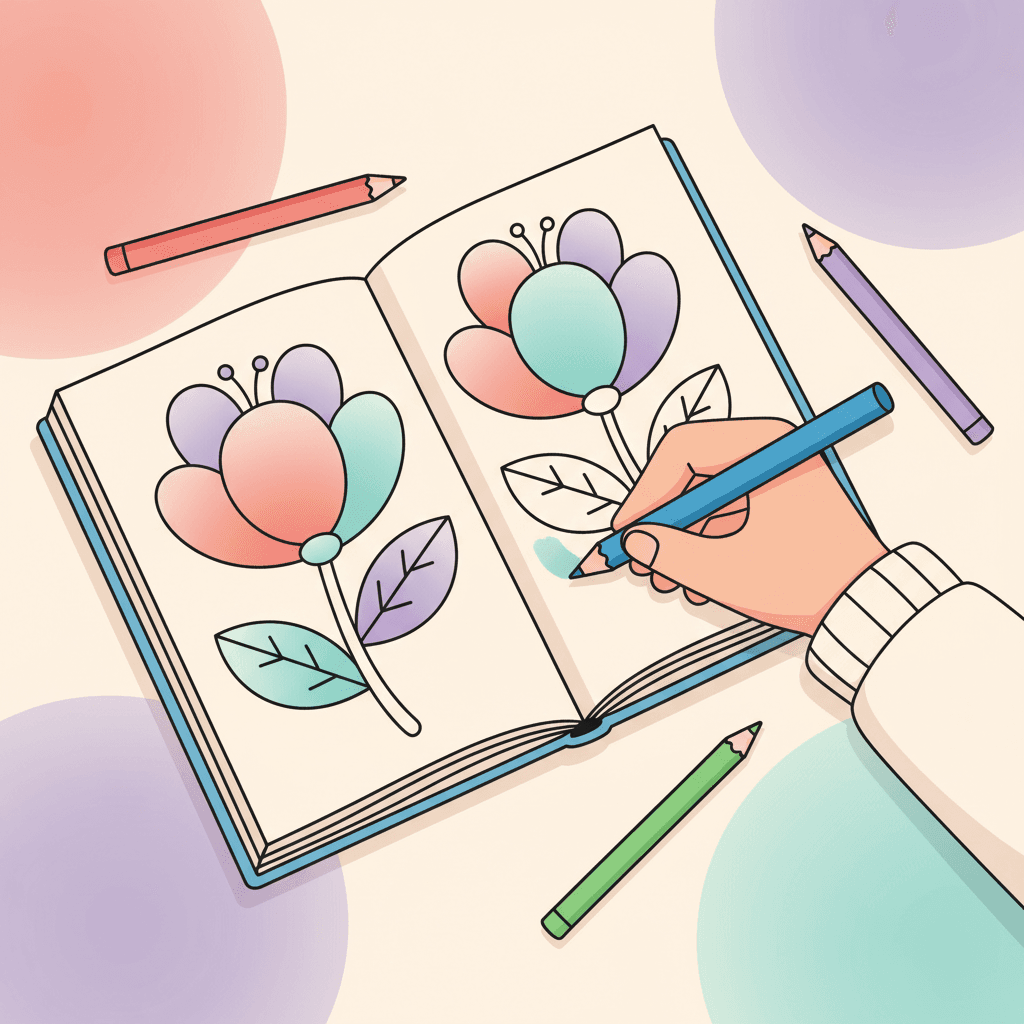
TL;DR: Pick where the light is coming from. Leave the lit side lighter. Make the opposite side darker. Blend the in-between with multiple light layers, not one heavy pass. That's shading. The rest of this article is for making it look actually good.
I colored a tiger last week and something was bugging me about it. The orange was fine. The stripes were fine. But the whole thing looked like a sticker. Flat. Pasted onto the page. No weight, no roundness.
Then I went back and added three shading passes: darker orange in the belly and under the chin, a thin stripe of deep brown where the legs meet the body, and a light cast shadow on the ground. Maybe five minutes of extra work. The tiger went from "coloring book" to "that actually looks decent."
Shading is the difference. It's what makes a circle look like a ball and a rectangle look like a box. And the good news is you don't need to be an artist to do it. You just need a plan for where to put your darks and your lights.
Quick start: the three-value cheat
The version I come back to on every page, simplified to the bone:
Pick where the light is coming from (top left if you're not sure) and scribble a little arrow on your scratch paper so you remember. Now look at whatever you're shading and split it mentally into three zones: the side catching the light (highlight), the middle area (mid-tone), and the side turned away (shadow).
Leave the highlight alone. Seriously, bare paper or one whisper-light layer. People shade the highlight too dark and wonder why the whole thing looks flat.
The mid-tone gets 2 to 4 gentle layers. Nothing crazy. Then the shadow area gets more layers and ideally a slightly darker pencil. Not black, please. A darker version of the same color, or something cooler like a deep blue or purple.
Last step: go back with the lighter pencil and work the edges where two zones meet. That's what turns three blobs of color into an actual gradient. The rest of this article is just refinements on top of that.
Picking your light source (and sticking with it)
I skipped this step for months. I'd just start shading wherever felt right on each shape and then wonder why the page looked off. The tree had shadows on the left, the house had them on the right, and the whole scene looked like it was lit by four different suns.
Now I pick one direction before I start and I don't change it. Top left is my default because that's how most reference photos I look at are lit. It also keeps my right hand from dragging through the shading as I work across the page. Top right would be better if you're left-handed.
Whatever you pick, draw a little arrow somewhere on the margin and glance at it when you move to a new object. The arrow is dumb and simple but it works. Without it I drift.
For coloring pages without any built-in shadow lines, I imagine a desk lamp sitting to the upper left of the page and shade everything as if that lamp was real.
How shapes tell you where to shade
Almost everything on a coloring page is secretly a sphere, a cylinder, or a box. Once that clicked for me, I stopped guessing where to put shadows.
An orange is a sphere. So is a head, a bubble, a Christmas ornament. The light hits one side and the shadow curves around the back. Here's the detail that took me a while to notice in real objects: the very edge of the shadow side is actually a bit lighter than the area just before it. That's reflected light bouncing off the table or ground back onto the object. Adding that thin light strip along the edge is a small thing but it's the difference between "I shaded one side darker" and "wow, that looks round." The actual darkest band sits just inside from the edge. Artists call it the core shadow.
Tree trunks, arms, candles, bottles, those are all cylinders. Same idea as a sphere but the light and dark run in vertical stripes instead of curving everywhere. Highlight stripe on the lit side, shadow stripe on the far side, smooth gradient between them.
Boxes are the easiest. Buildings, presents, books. Each flat face just gets its own value. The face aimed at the light is brightest, the face turned away is darkest, and any visible side face is in between. No gradients to worry about within each face, just make them clearly different from each other.
A flower petal? That's a curved sheet, somewhere between a cylinder and a sphere. Hair? Bundles of tiny cylinders. Fabric folds? A valley (dark) between two ridges (light). Once you start seeing these base shapes inside the coloring page designs, shading stops being mysterious.
Color choices for shadows (this is where most people go wrong)
I used to just press harder with the same pencil when I wanted an area darker. It sort of works until you've crushed the paper flat and there's nowhere left to go. Or you grab the black pencil and the whole shadow goes dead. I shaded a red rose with black shadows once and it looked like someone had smudged charcoal on it.
What actually fixed my shadows was picking up a different pencil for the dark areas. Not just darker, but a slightly different color. I was shading a red apple and on a whim grabbed a purple pencil for the shadow side instead of pressing harder with the red. It looked ten times better. Turns out shadows shift in color temperature: warm light (sunlight, lamp light) throws cooler shadows. So a red apple in warm light has shadows that lean toward purple, not just "more red." A yellow flower gets shadow that leans toward ochre or yellow-green, not gray.
You don't need to think about it in scientific terms. Just: when you go to shade something, reach for a pencil that's darker AND slightly different from your base color. Green leaf? Dark teal or forest green for the shadow, not the same green pressed harder. Pink skin? Try mauve or dusty rose for the shadows instead of brown.
Three shadow color strategies that I use depending on what I'm coloring:
Go one or two shades darker in the same color family. Light blue base, medium blue shadow, dark blue for the deepest parts. Simple and always works.
Use the complementary color very lightly under your shadow layers. A whisper of purple under yellow, a touch of green under red. This adds depth without muddiness as long as you keep it light. Go too heavy and it turns to gray soup.
Layer a cool dark (dark blue, indigo, dark purple) into your deepest shadows regardless of the base color. This is my go-to for anything that needs to feel dramatic. A tiny bit of indigo in the deepest fold of a red dress makes it look rich instead of just dark.
Carrie L. Lewis, who's been teaching colored pencil for decades, puts it well on her site: "If your values are strong, you can afford to fudge a little bit on color." Getting the light-to-dark range right matters more than picking the perfect shadow hue. I've found that to be true. A sphere with strong contrast and slightly "wrong" colors reads better than one with perfect color choice and weak contrast.
The six mark-making approaches
Different strokes work better for different situations. I use all of these depending on what I'm shading:
Circular strokes (scumbling) are my default for most coloring page work. Tiny overlapping circles that build up gradually. They hide individual stroke marks better than straight lines and create smooth-looking gradients. This is what I reach for first on skin, petals, fruit, and anything organic.
Hatching is parallel lines going in one direction. It creates a textured, illustrative look rather than a smooth one. I use it for things that have a directional grain, like wood, grass, or hair. The closer together the lines, the darker the area reads.
Cross-hatching is layers of hatching at different angles. More layers and more angles = darker and denser. This has a graphic, pen-and-ink kind of feel. I like it for shading detailed areas where I want visible texture, not smooth gradients.
Layering with directional changes is just alternating your stroke direction with each pass. First layer goes one way, second layer goes another. The overlapping strokes fill the paper tooth more evenly than going in one direction only. This is really just careful circular strokes done more deliberately.
Burnishing is going over your layered work with heavy pressure (usually a light-colored pencil or colorless blender) to crush the paper tooth flat and blend everything into a smooth, waxy surface. It looks polished and saturated. But it's a finishing move. Once you burnish, adding more layers on top is hard because the tooth is gone. Save it for last. I wrote more about this in how to blend colored pencils.
Stippling is dots instead of strokes. Slow but creates an unusual, pointillist texture. I rarely use this for coloring pages but it's interesting on backgrounds or sand textures.
Which one to use when? Honestly, I mix them. Circular strokes for the base layers, then I'll switch to directional hatching for areas that need texture (hair, bark, fabric weave), then burnish the smoothest areas (skin, sky, water) at the end.
Shading with a small pencil set
If you only have 12 or 24 pencils, you can't always grab a darker shade of the same color because you might not have one.
Here's what I do with a 12-pack: I pick one dark pencil as my universal shadow color. Dark brown or dark blue works for almost everything. I layer it very lightly into the shadow areas before I put down my main color, then shade over it. The dark undertone shows through just enough to create depth. You only need a whisper of it.
With a 24-pack you usually have enough range to find a darker shade for most colors, but the same trick works for any gaps. That one dark blue pencil has been my shadow pencil for months.
Another trick for limited palettes: layer two colors that you do have to create a shadow you don't. Light green plus light brown makes a convincing dark green shadow. Light blue plus purple makes a good deep blue.
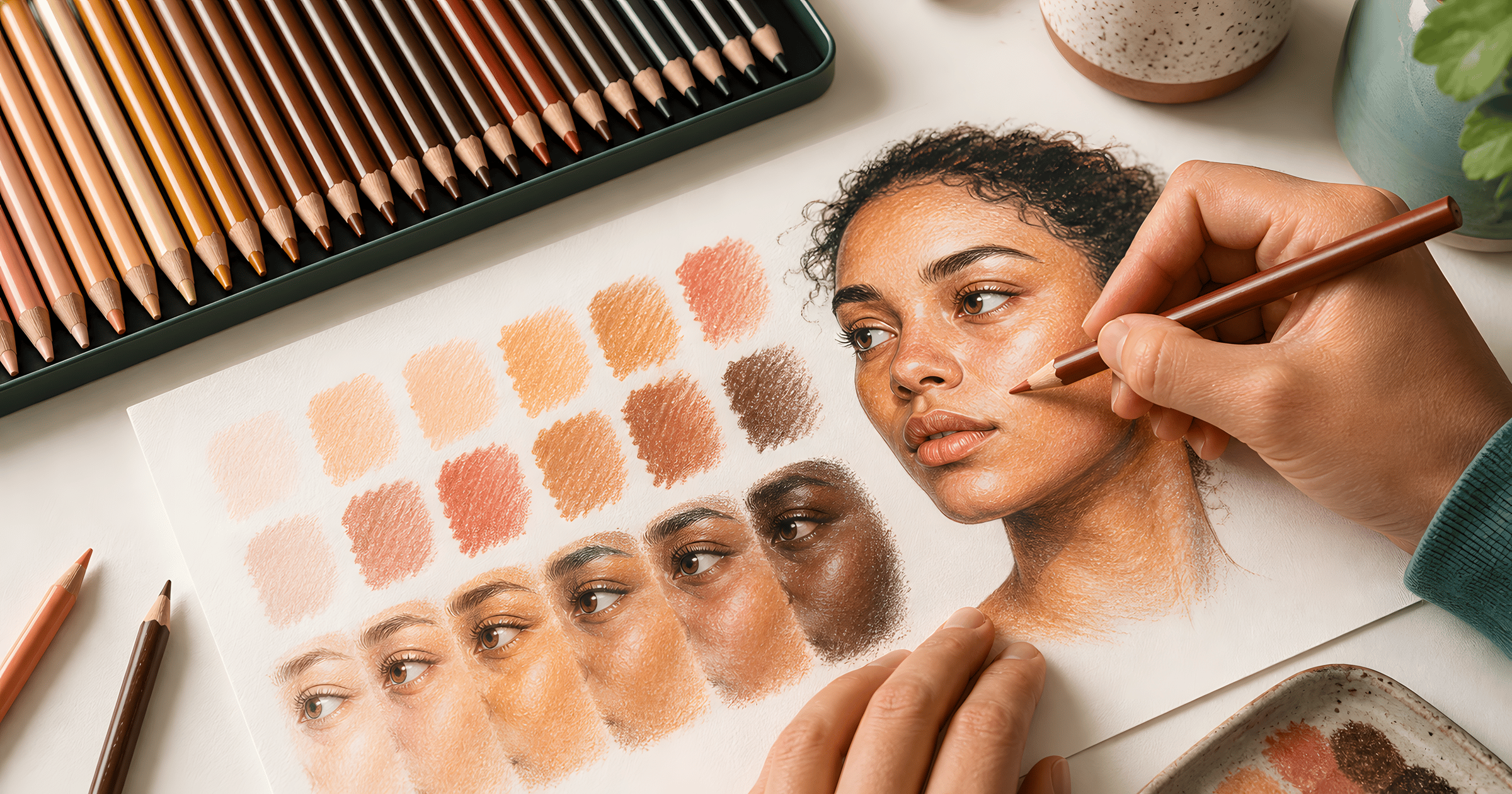
The same layering logic is the whole engine behind coloring skin tones, which is the natural next drill once spheres feel easy.
Wax bloom (the white haze problem)
If you're using wax-based pencils like Prismacolor Premiers and you shade an area heavily, you might come back the next day and find a whitish haze sitting on top of your color. That's wax bloom. The wax binder in the pencil rises to the surface as it cools and hardens.
It looks alarming the first time it happens. But it's easy to fix: just lightly wipe the surface with a soft cloth or tissue. The color is still underneath. Some people also give their finished work a spray of fixative to prevent it from coming back.
Oil-based pencils like Faber-Castell Polychromos don't get wax bloom. So if it really bothers you, that's one reason to look at oil-based options. But for most coloring page work, wax-based pencils are fine as long as you know the haze is temporary.
Keeping your edges
This is something I had to learn by messing it up. When you shade, especially with circular strokes and multiple layers, the edges of shapes start to disappear. The border between a petal and a leaf gets soft and muddy. The outline of an arm blurs into the background.
Veronica Winters, a professional colored pencil artist, has a good rule on her site: "Re-define and outline the sharpest edges during your entire shading process because they tend to disappear during shading." I keep a sharpened dark pencil nearby while I shade and periodically go back to re-trace the edges that are getting lost. Not every edge. Just the ones between objects or where two contrasting areas meet.
Exercises that actually taught me something
The pressure gradient strip
Take one pencil and make a strip from lightest possible to darkest possible. Not by switching pencils, just by adding layers and gradually increasing pressure. Try to make the transition perfectly smooth with no visible jumps. This teaches you your pencil's full range, which is wider than you think. Most beginners only use the middle third.
The sphere
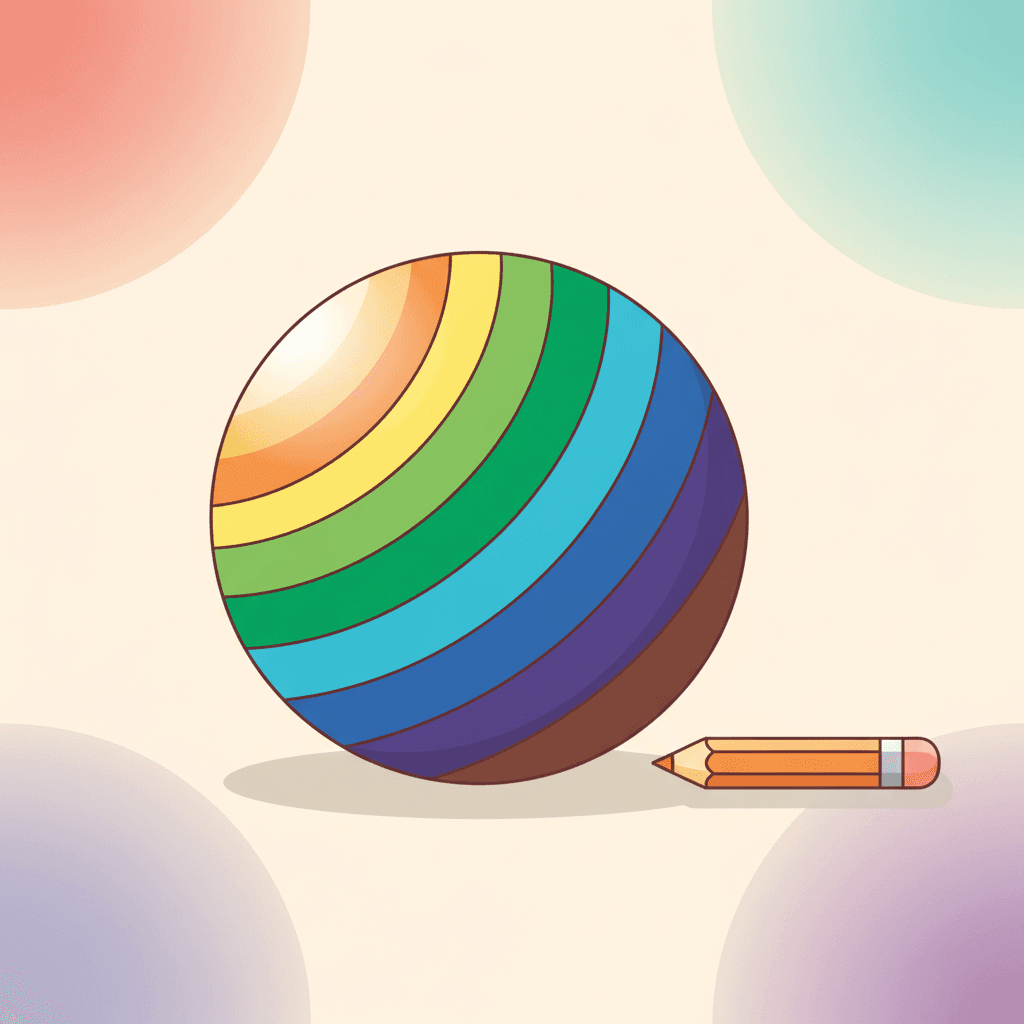
Draw a circle about the size of a tennis ball. Pick your light source (top left). Shade it into a sphere using the three-value approach: leave a highlight, build a mid-tone, add a dark core shadow band, and put a cast shadow on the "ground" below. When the circle starts looking round instead of flat, you've got it.
I do one of these as a warm-up almost every time I sit down to color now. Takes maybe three minutes and gets my hand calibrated.
The fabric fold
Draw two S-curves close together, like the top edge of a draped curtain. The ridges (tops of the curves) are light. The valleys (where fabric dips away) are dark. Shade accordingly. This one is trickier than the sphere because the light-to-dark transition happens over a short distance and repeats. Good practice for anything with clothing, hair, or flowing shapes.
Paper and pencils for shading
Paper matters more for shading than for flat coloring. You're building 6, 8, 10+ layers and you need the surface to hold up without getting slick or pilling.
For casual coloring pages I print at home, 32 lb premium printer paper handles about 4 to 6 layers before the tooth fills up. That's enough for basic three-value shading. When I want to push further, like heavy burnishing or 10+ layer builds, I switch to Bristol vellum. The difference is night and day. The tooth lasts longer and the finished result is noticeably smoother. For paper details, see best paper for printing coloring pages.
As for pencils, I started with a $12 Crayola set and still learned to shade with it. You don't need fancy pencils to learn the fundamentals. That said, I eventually picked up Prismacolor Premiers and the blending got way easier. They're soft, creamy, lay down color fast. But they snap if you look at them wrong and they get wax bloom (that white haze I talked about earlier).
Then someone lent me their Faber-Castell Polychromos and I understood why people spend $2 per pencil. They're harder, so they sharpen to a real point that's great for tight areas and shadow detail. No wax bloom either. The tradeoff is they take more passes to get deep color. These days I grab Polychromos for fine work and dark shadows, Prismacolors when I want to cover a big area fast. But honestly? Use what you've got. A 24-pack of anything is enough to learn everything in this article.
Troubleshooting
"My shading looks dirty or muddy"
Probably too many unrelated colors layered without a plan. Or you pressed too hard on early layers and now everything is mixing into a grayish mess. The fix: limit your shadow palette. Pick one dark pencil for shadows and use it consistently. Build layers lighter than you think you need to. You can always add more. You can't take it back.
"It looks flat even though I shaded it"
Not enough contrast. This was my biggest problem for months. I'd shade something and feel like I'd added depth, then I'd take a photo and it looked the same as before. The issue was I wasn't going dark enough in my shadows. Your eye adjusts as you work and tricks you into thinking you have more range than you do. Step back. Squint at it. If you can barely tell where the shadow is, go darker. Much darker than feels comfortable.
Carrie L. Lewis captures this perfectly on her blog: "Every piece goes through an awkward or ugly phase." The stage where your shading looks blotchy and wrong is normal. Keep layering through it.
"I can't blend the transition between light and dark"
More layers is usually the answer. Go back with your lightest pencil and gently work the edge where your two zones meet. Change your stroke direction. If that's still not enough, try a different paper with more tooth. Smooth paper fills up fast and stops accepting pigment. See how to blend colored pencils for technique details.
"I went too dark and now I can't fix it"
This one is hard. Heavy pressure fills the tooth and there's no room for more pigment. Your options: use a kneaded eraser to lift some pigment (blot, don't rub, or you'll smear it). Or try the fixative trick that Veronica Winters recommends: spray a light coat of workable fixative, let it dry completely, and it creates a new surface you can layer on top of. I've had mixed results with this but it's worth trying before you give up on a piece.
"The white specks in my shading won't go away"
Those are the paper tooth peeking through between pigment layers. You need more layers, or you need to burnish. Going over the area with a lighter pencil using firm pressure will push pigment into the valleys. Or use a colorless blender pencil. If the specks really bother you, you might need paper with finer tooth.
Watch: shading with colored pencils
See also: Colored pencil shading and layering demo (TikTok)
Further reading
- Colored pencil techniques: a practical guide (The Virtual Instructor)
- 4 common colored pencil mistakes (Carrie L. Lewis)
- 4 best colored pencil shading techniques (Veronica Winters)
- How to blend and shade for adult coloring books (ColorIt)
FAQ
Should I use black for shadows?
I almost never do. Black flattens shadows and makes them look like holes instead of depth. A dark brown, dark blue, or dark purple gives you a richer result that still feels like a color, not an absence of color. The only time I'll use black is in tiny accents, like the deepest fold of very dark fabric or the pupil of an eye.
How do I shade on tiny detailed coloring pages?
Don't overthink it. In small sections, you can't fit a full three-value gradient. Two values is plenty: a light base and one shadow pass on the darker side. Keep your pencil sharp and use less pressure. The small sections add up and the page reads as shaded even if each piece only has two tones.
Wax-based or oil-based pencils for shading?
Both work. Wax-based (Prismacolor, Caran d'Ache Luminance) blend faster and lay down color quickly but can bloom. Oil-based (Faber-Castell Polychromos) need more layers for the same intensity but give you finer control and no wax issues. I reach for wax-based when I want speed and oil-based when I want precision. If you only have one set, use it. The pencil type matters less than your pressure and layering.
Can I shade coloring pages I printed on regular paper?
Yes, but you'll max out at about 4 to 6 layers before the tooth fills up. That's enough for basic three-value shading. If you want to go heavier with burnishing or lots of layers, print on thicker paper. See how to print coloring pages and best paper for printing coloring pages.
How long does it take to shade a full page?
Depends entirely on how detailed the page is and how far you take the shading. A simple kids' page with basic two-value shading, maybe 20 minutes extra. A detailed adult coloring page with full three-value shading, burnishing, and multiple color layers? Could easily double your coloring time. I've spent 3 hours on a single mandala when I'm really going for it. But basic shading (light side lighter, dark side darker) adds maybe 30% more time and makes a huge difference.
For the fundamentals of colored pencil technique, see how to color with colored pencils. For blending specifics, see how to blend colored pencils. Or browse coloring pages and try shading a sphere in the corner before you commit to the whole page.