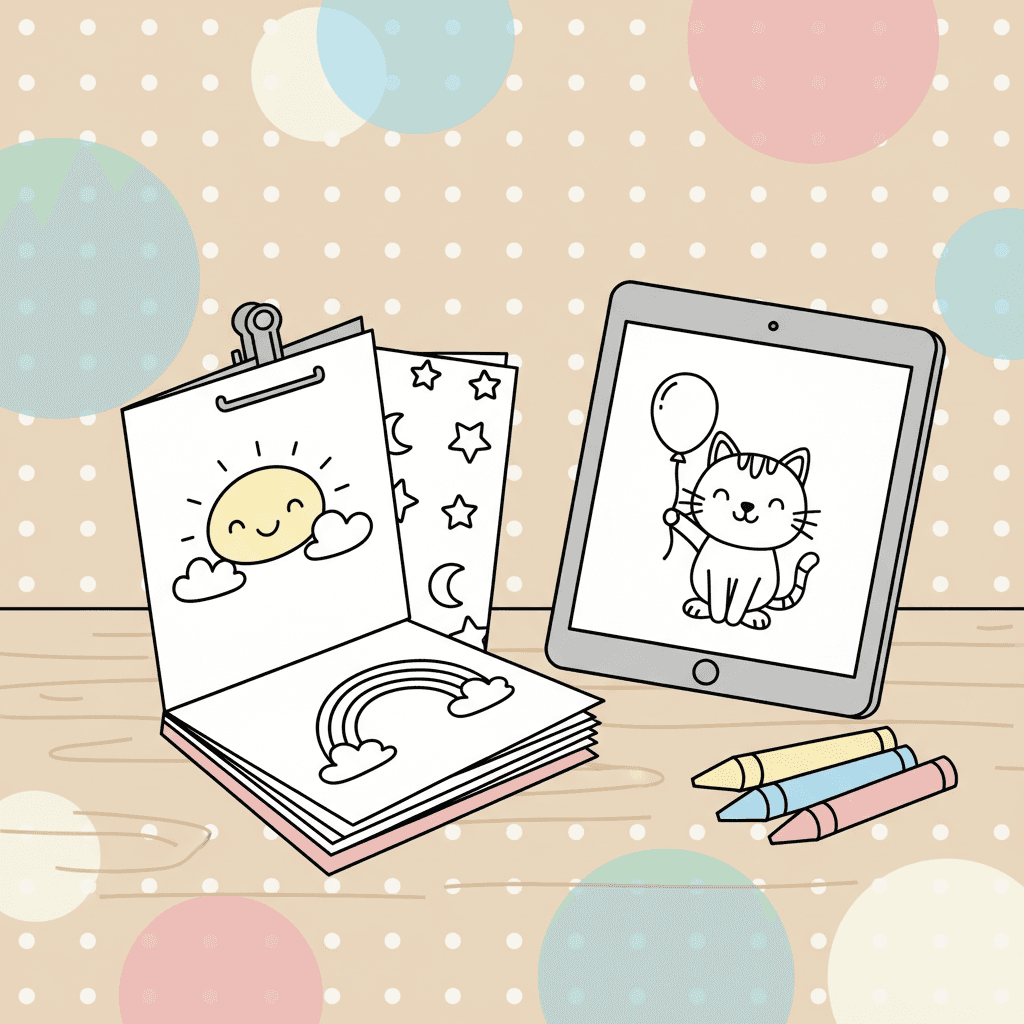
Bedtime can turn into "one more page" fast. Coloring can genuinely help kids wind down, and it can also do the opposite, which most bedtime-coloring articles won't tell you. Whether it calms or activates your kid depends almost entirely on the setup: page choice, timing, light, and the stop rule.
We've run coloring in our own bedtime rotation for over a year now. Some of what I expected to work didn't (detailed pages, "just five more minutes" flexibility). What survived is a routine short enough that it never becomes the reason bedtime ran late.
The honest part first: coloring isn't automatically calming
Sleep guidance for kids, like the pre-bedtime activity list from Sheffield Children's NHS Trust, recommends quiet, non-stimulating fine-motor activities before bed, and coloring is on that list. But "non-stimulating" is doing a lot of work in that sentence.
Coloring activates some kids. If your child treats every page as a design project, agonizes over palettes, or gets a second wind from creative decisions, an open-ended coloring session at 7:45pm is a mistake. The fix isn't dropping coloring; it's removing the stimulating parts:
- few decisions: page chosen in advance, palette limited to 3 colors
- low stakes: a page they've colored before, or one with no "important" part to ruin
- short and bounded: 8 to 12 minutes, timer visible
Calm comes from the repetitive filling, not from the creativity. Strip the session down to the filling.
Worth saying plainly: no study shows coloring specifically improves children's sleep. What's supported is that consistent wind-down routines improve sleep, quiet fine-motor activities are recommended components of those routines, and coloring has small-to-moderate calming effects in short sessions. Coloring is a good brick in the routine, not the foundation.
Choose pages that feel sleepy
At bedtime you want the opposite of a challenge page: one main subject, big regions, no busy patterns. Even better, pick subjects that are themselves asleep. Kids notice this more than you'd expect; there's a small, real difference between coloring a rocket launch and coloring a cat who is already doing what you want your kid to do.
Our most bedtime-appropriate pages:
- The sleepy kitten, the reigning champion in our house
- The cat napping in a window
- The unicorn on a sleepy moon
- The moon and clouds
- The sleepy monster, for kids who like their wind-down slightly silly






For broader calm themes, Animals, Nature, and Ocean are the safe shelves. If your kid lobbies for detailed pages, allow them with one rule: a clear main subject and a clear starting point, or it waits for the weekend. The age guide helps calibrate difficulty.
Paper vs. digital at night
Both can work, but the defaults are different at bedtime than at 3pm:
| If you need... | Choose... | Why |
|---|---|---|
| No screens in the bedtime zone | Printable | The simplest possible wind-down |
| Zero setup and no supplies out | Digital | Tap and start |
| Fewer tears over mistakes | Digital | Undo ends the perfectionist spiral |
| One page per kid, no sharing | Printable | Cheap to duplicate |
If you go digital at night, treat the screen like a lamp: brightness down, night-mode color temperature on, full screen so there's nothing else to tap, page picked before the timer starts. Then stop 30 to 60 minutes before lights-out rather than right at the end, so the screen isn't the last thing before sleep. If you'd rather keep all screens out of the last hour, print the page in the afternoon; these printer settings take two minutes.
Our take on making screen-based coloring feel more like an activity and less like screen time is in this guide.
Where it fits in the bedtime sequence
Coloring belongs after the active parts of bedtime are done, in the "we are slowing down now" slot:
- Pajamas → coloring → brush teeth → story → lights out
- Bath → brush teeth → coloring → story → lights out
Pick one order and hold it for a week before judging. The consistency, not the coloring, is what makes it calming; the coloring is just a pleasant thing to be consistent about.
If your kid needs more sensory wind-down than a quiet activity provides (deep pressure, weighted input), coloring stacks well after those rather than replacing them. This short video covers the sensory side:
The 4-step routine
Step 1: pick the page before bedtime starts. Ideally at breakfast, or assign a theme per week ("this week is Animals"). Choosing at 7:45pm invites a browsing session, and browsing is stimulation. Our fast-picking guide exists for exactly this.
Step 2: choose a small palette. Three to five colors, chosen by the kid, before the timer. Bedtime coloring should feel like coasting downhill, and every open decision is a pedal stroke. Stuck kids get a ready-made set from kid-friendly palettes.
Step 3: timer on, rule said once. 8 to 12 minutes; 6 to 8 for kids under five. "When the timer beeps, we save and stop." Then stop coaching. A parent narrating color choices at 8pm is, I've learned firsthand, a stimulant.
Step 4: stop on purpose. The closing action matters more than the coloring: unfinished page goes in a "tomorrow" folder, crayons in the bin, or progress saved if you colored online. The folder is the trick; an unfinished page with a designated home stops being an open loop that follows your kid to bed.
Scripts for "one more page"
The request is normal, and it's also exactly where bedtime slides. Responses that hold the line without a fight:
- "We can save a new page for tomorrow. Pick it now if you want."
- "You can finish one section, then we stop."
- "The timer already decided. Tomorrow it's your turn to decide the page."
If the routine keeps stretching anyway, the boundary problem is upstream: pages not chosen in advance, inconsistent timer, or coloring placed too close to lights-out where every extra minute directly costs sleep.
One minute of co-play, then step back
You don't need to color the whole page with them. Start together for sixty seconds: ask what they'll color first, help pick the first color, restate the stop rule. Then step back. Kids reliably stay settled longer after a short shared start than after either extreme (fully solo or parent hovering throughout).
If coloring wakes your kid up
Change one variable at a time, in this order:
- Shorten the timer to 6 minutes.
- Cut to two or three colors.
- Swap to a simpler page with bigger shapes (the sleepy kitten level).
- Switch from screen to paper in a dimmer room.
If it's still revving them up after all four, coloring is a daytime activity for your kid; move it to the after-school or post-practice slot and use books or audio at night. No single wind-down works for every child, and forcing this one defeats its purpose.
Tonight's version: the sleepy kitten, three colors picked at dinner, ten minutes, folder for the unfinished page, then story and lights out.