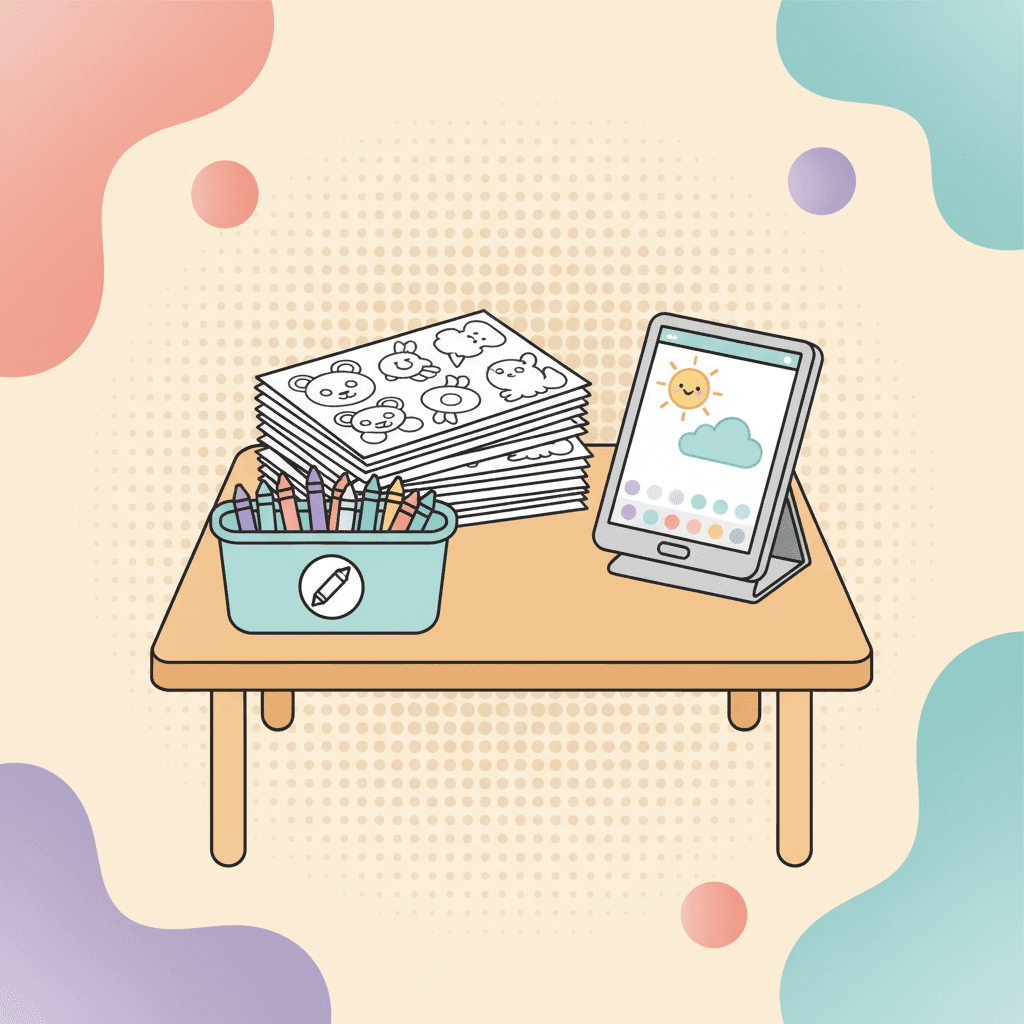
Early finishers are not the problem. The problem is what happens next.
If "I am done" turns into wandering, noise, and constant questions, a simple coloring system can save your transitions.
This guide gives you a classroom-ready setup that stays quiet, works for mixed abilities, and does not create supply chaos.
The goal: predictable, independent, quiet
Early finisher activities work when they are:
- easy to start with no teacher help
- easy to stop and clean up
- quiet enough for ongoing instruction
Coloring fits these goals when the pages are chosen well and the rules are clear.
If you want a full station setup for centers, this guide pairs well with early finishers:
Build your early finisher coloring system in 10 minutes
You do not need an elaborate binder. Start with a small, repeatable kit.
1) Pick one theme per week
Theme-first choice reduces decision time and arguing.
Good weekly themes:
2) Print two stacks: easy and more detail
Mixed ability is normal. Two stacks solves most matching problems.
- Easy stack: bigger shapes, fewer tiny regions.
- More-detail stack: patterns and smaller regions for older kids.
This guide helps you sort pages quickly:
3) Put supplies in one labeled bin
One bin prevents supply drift. You can hand it out, collect it, and count it quickly.
4) Add a "finished" tray
Kids need a clear place to put work when done. A finished tray also prevents pages from becoming airplanes.
The rules that prevent most problems
Say the rules once; post them if you can. Then repeat them without negotiating.
These rules work in most classrooms:
- Choose one page; start coloring within 30 seconds.
- Use the supplies in the bin; do not swap with friends.
- Names go on the back.
- Finished pages go in the finished tray.
- You may color only during early finisher time.
If you want fewer "can I get another page?" requests, add one more:
- One page per early finisher block; save another for tomorrow.
Prevent rushing and scribbling
Some students will speed-run a page to earn a new one. Set a simple quality rule so coloring stays calm and purposeful.
Try one of these:
- You color for the full early finisher block.
- You finish five areas before switching pages.
- You may get a second page only after your first is neat and named.
If you see constant frustration, swap the page to an easier stack. Difficulty drives behavior.
Match pages to your students without turning it into a lesson
If students get stuck, it is usually a page match problem. The fix is a simpler page, not more reminders to focus.
Use this quick sorting approach:
- K to 1st: pages with one main subject and big regions.
- 2nd to 3rd: simple scenes with two to five objects.
- 4th+: more detail pages with patterns and backgrounds.
If you want an easy way to offer challenge without stress:
- Put one "detail stack" page in a folder labeled "Try if you want more detail."
For older kids who want a challenge:
Keep supplies from walking away
Supply problems create teacher work. Make the system do the work instead.
Try these low-effort controls:
- Use short crayons for stations; they stay in the bin more often.
- Color-code the bin with tape so it is easy to spot.
- Keep one "missing crayon" cup in the bin so kids stop hunting in desks.
If you allow markers, add a scrap sheet under pages to reduce bleed-through.
Keep it fresh without adding work
Kids get bored when the same pages sit out for weeks. You can rotate themes without building a new system.
Use a simple rotation:
- One theme per week.
- Retire finished pages to a folder.
- Refill both stacks on Friday in one batch.
If you want students to feel ownership, let them vote on next week's theme from two options.
Digital option: one tablet station for small groups
If you have devices, a single tablet station can work as an early finisher option. It is easiest when you treat it like a station, not free time.
Digital early finisher rules that work:
- One page per turn.
- A timer decides turns.
- Save at the end of the turn.
- Full screen only; no browsing.
If you are choosing between print and digital for your room:
Make it sub-friendly with one instruction card
If you want this system to work when you are out, add one small instruction card:
- where the pages are
- where the supply bin lives
- the early finisher rules
- where finished work goes
Subs can run the system without asking you questions at 8:10 a.m.
If you want a quick quality check for any page set you use:
Start with one theme next week
Pick a theme, print two stacks, and teach the routine once. When early finishers know what to do next, your room gets quieter without extra effort.