Our old routine had a coloring page that never actually finished. Every night my son found one more region, then one more after that, and somehow "one more" kept talking me into ten extra minutes I genuinely didn't have. Took me embarrassingly long to notice the pattern.
A routine that works has to be short enough to repeat, predictable enough that a tired kid already knows what's next, and loose enough to survive an actual family's actual Tuesday. Thirty minutes, same order every night, works as a solid default: bathroom and pajamas, one quiet activity, one short book, lights out. Coloring can fill about eight minutes of that quiet slot. It's optional though, not a requirement, and if it winds your kid up instead of settling them down, move it earlier or drop it entirely.
Worth saying plainly: coloring isn't a sleep treatment. There's no real evidence it makes kids sleep, specifically. What actually helps is a consistent schedule, a calm environment, and cues repeated enough that the brain stops needing to think about them. The CDC's guidance on building structure leans hard on consistency and predictability. Coloring's just one pleasant cue some families happen to like.
Tonight, quickly: pick one simple paper page before dinner. Thirty minutes before lights out, dim the house. Pajamas, teeth, toilet. Color for eight minutes. Put the unfinished page in a tomorrow folder. Read one short book. Lights out.
The routine, roughly mapped out
Treat the clock as a guide, not a test your family can fail at.
| Time before lights out | What to do | Keep it easy by... |
|---|---|---|
| 30 minutes | Lower lights and activity | Ending rough play and putting away noisy toys |
| 25 minutes | Toilet, teeth, pajamas | Laying pajamas out earlier |
| 15 minutes | Quiet activity | Coloring one preselected page for 8 minutes |
| 7 minutes | One short book or song | Choosing it before getting into bed |
| 0 minutes | Lights out | Using the same final sentence each night |
For a 7:30pm lights-out, that maps out like this:
| Clock time | Step |
|---|---|
| 7:00pm | Dim lights; bathroom and pajamas |
| 7:15pm | Color one page at a table or desk |
| 7:23pm | Put page away and get into bed |
| 7:25pm | Read one short book |
| 7:30pm | Lights out |
Bath night running long? Start fifteen minutes earlier instead of cramming a bath, coloring, and two stories into the same half hour and hoping the ending stays calm anyway. It won't.
Start from sleep need, not a bedtime you picked arbitrarily
Kids ages 3 to 5 generally need 10 to 13 hours of sleep across 24 hours, naps included, per the CDC's sleep-duration guidance. That's a range, not a prescription written specifically for your kid. Wake time, naps, temperament, health, all of it factors in.
Work backward from there.
- Write down when your child actually wakes up, not the time you wish they woke up.
- Note whether naps are still happening, and roughly how long.
- Pick a realistic lights-out that leaves room for their actual sleep need.
- Start the routine 30 minutes before that.
- Hold the pattern for about a week before deciding it's not working, unless your kid's clearly getting more distressed or losing real sleep along the way.
A preschooler waking near 6:30am with no nap left probably needs an earlier bedtime than one still taking a long afternoon nap, for what it's worth. A late nap can also quietly wreck a bedtime that used to work fine. No routine manufactures sleep pressure that isn't already there.
Shifting bedtime? Move it gradually. The Sleep Foundation's guide suggests small, steady changes, repeating a few activities in the same order rather than overhauling everything at once.
Is coloring even the right bedtime activity here?
Coloring works best as a bridge between movement and a story, not as the final event right before sleep.
| What you notice | Try coloring at bedtime? | Best adjustment |
|---|---|---|
| Repetitive coloring makes your child quieter | Yes | Use one simple page for 6 to 10 minutes |
| Page selection turns into endless browsing | Maybe | Select the page before dinner |
| Mistakes trigger tears or restarting | Maybe | Use digital undo earlier in the evening, or a familiar paper page |
| Creative projects give your child a second wind | No, not late | Move art to after dinner and use a book at bedtime |
| Your child fixates on finishing every region | Maybe | Use a tiny page section or a clear stop point |
| Screens are hard to hand back | Use paper | Print in advance and keep the tablet out of the bedroom |
We've run coloring through our own bedtime rotation for over a year now. Detailed pages and a flexible "just five more minutes" sounded reasonable on paper and stretched the night out almost every single time. What actually survived, long term, was small: a simple page, a tiny palette, a timer, a folder that makes an unfinished picture feel saved rather than abandoned.
That's experience talking, not a clinical study. Your own kid's reaction is the real test here. If coloring keeps producing more negotiation or more energy after several honest tries, it's the wrong tool for your bedtime, full stop.
Building it, step by step
A clear start signal
About thirty minutes out, change the environment before you say a single word. Dim the main room. Stop the chase game currently happening. Turn the household volume down a notch. A repeated signal means you stop having to announce that bedtime's coming, over and over, every night.
One short line does the transition:
"The big lights are off. Bathroom, pajamas, quiet time, book, then bed."
If transitions are hard for your kid specifically, draw those five steps on index cards and let them flip each one as it's done. The CDC's routines guidance gets into why repetition like this actually teaches kids what to expect next.
Body-care stuff comes before the quiet activity
Toilet, teeth, pajamas, any bedtime medication, the final drink, all of it before coloring starts. Otherwise the kid sits down at the table and you end up restarting the whole transition two or three times anyway.
Keep water available. Just don't let the last drink of the night turn into its own separate event. Pajamas within reach, and two acceptable choices instead of the whole open drawer.
The eight-minute coloring wind-down
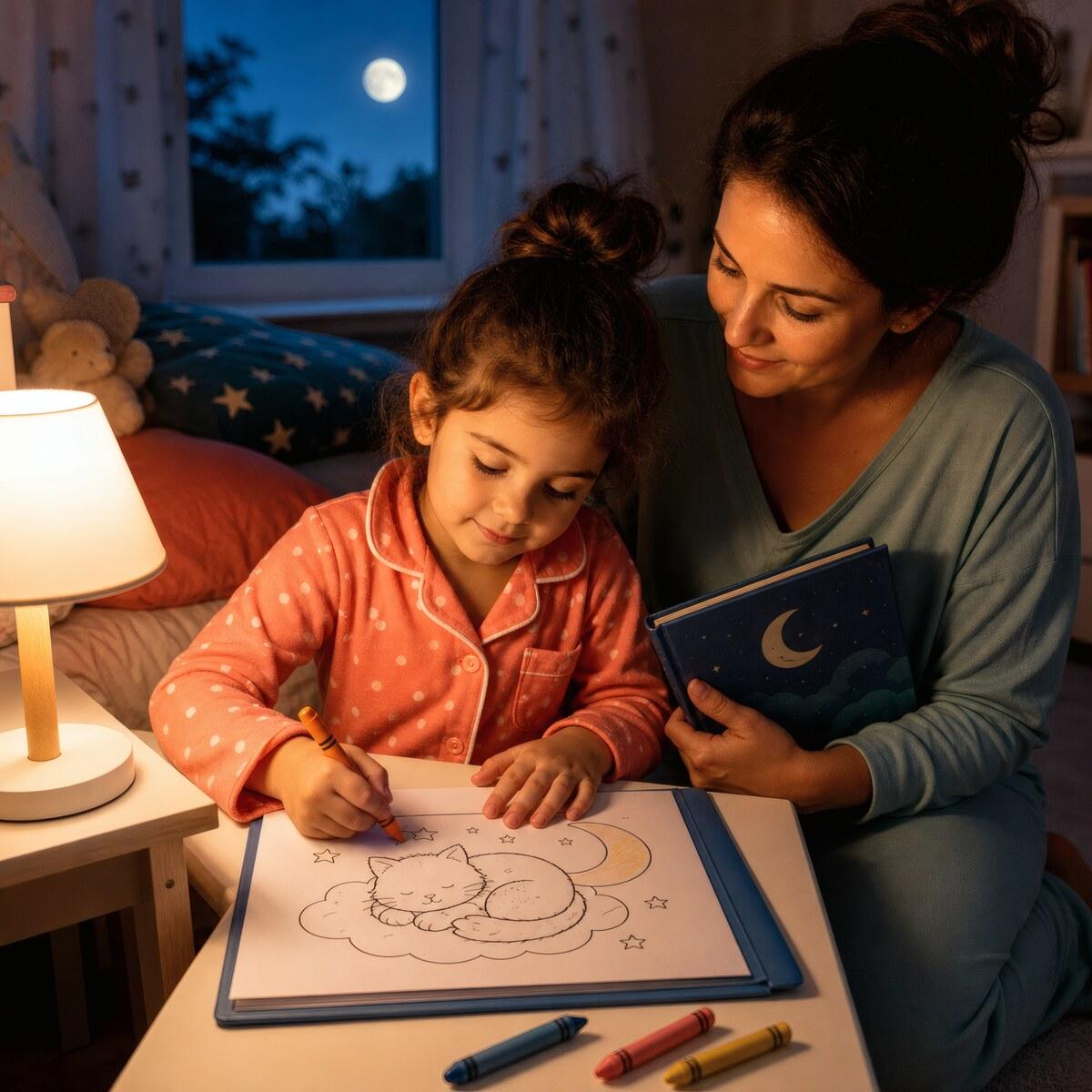
Get the page and three to five crayons ready before your child even sits down.
- Point to one easy starting spot.
- Set a visible timer for 6 to 10 minutes — six's usually plenty for a younger preschooler, ten's the upper limit for this whole routine.
- Say the ending once. "When the timer rings, this page sleeps in the folder."
- Color together for the first minute if they need help getting started.
- Then step back. Don't narrate every color choice they make.
I learned that last one the slow way. Asking enthusiastic questions about every single crayon kept the conversation going, and kept my kid fully, annoyingly awake. Sitting quietly together worked better than hovering through the whole page ever did.
Ending coloring without demanding it's finished
Finishing was never the actual goal here. Pick one closing line and stick with it.
- "Choose one last shape."
- Put a star beside where tomorrow starts, if a visual marker helps more than words do.
- "The page goes in the tomorrow folder now."
- Tap save, then the tablet charges somewhere outside the bedroom. Every night, no exceptions.
Don't add time just because the page is nearly done. That teaches a kid the timer's the opening move in a negotiation, not the actual end. If a hard stop causes real distress, add a two-minute warning and a last-shape warning instead, but keep the actual end time exactly where it was.
The same short finish, every time
Move from coloring into one book, one song, or a short cuddle. Close with the same sentence every night. Something like "you're safe, you're loved, and it's time to rest" works fine, or whatever version fits your family. Then leave the room the way you already do.
The quiet activity's allowed to rotate through different options. The final sequence stays fixed no matter what night it is. That's what makes it useful in the first place.
Pick pages that feel easy, not impressive
At bedtime, go for one clear subject, big regions, minimal clutter. A kid who loves detailed art most afternoons might still do better with something simpler once they're actually tired. Sleep-themed pictures make the whole transition feel coherent too, though the picture itself has zero magic sleep effect on its own.
A few starting points from our library:
- Sleepy kitten for large, familiar shapes
- Cat napping in a window, a cozy little scene
- Unicorn on a sleepy moon for the fantasy-obsessed kid
- Moon and clouds for something simple
- Sleepy monster, a bit more playful






If your kid quits because the shapes are too fiddly, go a size simpler with the easy pages. And pick the three colors yourself before the routine starts, so the palette debate never happens.
Paper or a screen, at this hour specifically
Paper's the safer default in that final hour. It removes notifications, brightness, browsing, and the whole hand-back battle in one move. Mayo Clinic's preschool sleep guidance recommends screens off about an hour before bed, and a generally quiet house as bedtime approaches.
| Situation | Better choice | Setup |
|---|---|---|
| You want a screen-free final hour | Paper | Print before dinner; place 3 crayons beside it |
| Mistakes cause a perfectionism spiral | Digital, earlier | Use undo, then end the screen before the final routine |
| Two children need separate work | Paper | Print two copies or two equally simple pages |
| Supplies create more work than calm | Digital, earlier | Full screen, low brightness, no browsing |
| The tablet is hard to surrender | Paper | Keep the device out of sight from the start |
Using digital coloring at all? Do it earlier in the evening, then bridge the screen-free stretch with bathroom, pajamas, and a paper book. Brightness down, warmer display mode on, and the page already open before you hand the tablet over. The printing guide speeds up the paper side of things.
A five-minute visual chart
Preschoolers can't read a clock, but they can absolutely follow a picture sequence. Draw or print five small cards.
| Card | Picture to draw | Child's job |
|---|---|---|
| 1 | Toilet and toothbrush | Finish bathroom jobs |
| 2 | Pajamas | Get dressed for bed |
| 3 | Crayon or quiet toy | Do one quiet activity |
| 4 | Book | Choose one short story |
| 5 | Moon | Get into bed; lights out |
Line the cards up left to right, at your kid's actual eye level. Let them flip a card or move a clothespin after each step's done. If tonight looks different for some reason, swap the relevant card before starting and explain the change once, briefly. The chart's job is clarifying the evening. It shouldn't turn into another reward system you now have to manage on top of everything else.
What to actually say when bedtime stretches
"One more page"
Try saying: this page's sleeping in the folder now. You can pick tomorrow's page tonight, or at breakfast.
Don't offer a second full page as a compromise, tempting as it is at 8:15pm. If ending mid-page is consistently a struggle, color only one defined section from the start instead of the whole thing.
"I'm not tired"
Try saying: you don't have to make yourself fall asleep. Your job's resting quietly. My job's keeping bedtime steady.
Some nights a kid genuinely isn't sleepy yet, especially after a late nap that ran long. Keep the room boring and calm instead of arguing about a feeling that's probably real.
"I need another drink, a hug, one more bathroom trip"
Build one drink, one hug, and the toilet trip into the chart itself. Answer repeat requests briefly and the same way every time, based on what your household actually needs. And never restrict a real bathroom need, obviously.
"I'm scared"
Treat fear as real, not as stalling for time. Check the room together. Name whatever the actual concern is. Offer one small, predictable comfort, then return to the routine. Try not to let the check itself grow into an elaborate nightly search that gets longer every week.
"My picture isn't perfect"
Use a familiar page, fewer colors, or move digital coloring earlier in the day entirely. At bedtime itself, try: it doesn't need to be finished or fixed. The folder's got it for tomorrow.
Troubleshooting, symptom by symptom
| What is happening | Likely friction | Change tomorrow |
|---|---|---|
| Child becomes sillier during coloring | Page or conversation is stimulating | Use a simpler page, stop coaching, or remove coloring |
| Routine takes an hour | Too many optional steps | Keep one quiet activity and one book |
| Child melts down at the timer | Ending is surprising | Give 2-minute and last-shape warnings |
| Child keeps leaving the room | Needs are handled too late | Move toilet, water, and comfort check earlier |
| Siblings wind each other up | Shared space is too social | Stagger starts or use separate surfaces |
| Bedtime moved later after a nap | Sleep pressure is lower | Review nap timing; keep the routine calm but do not force sleep |
| Routine works for one parent only | Cues or limits differ | Write the five steps and use the same ending sentence |
Change one thing at a time, across several nights, instead of rebuilding the whole evening after one rough bedtime. You need enough repeats to actually know whether the change helped or you just got lucky.
A few common situations
Two preschoolers, or a real age gap between them. Give each kid a separate page and the same timer running for both. Don't hand a tired pair one small crayon set to share, that's asking for trouble. An older sibling can read while the younger one colors, then both move to the story together. For daytime cooperation, we've got a separate guide on sibling activities — bedtime just isn't the moment to also be teaching sharing.
Travel nights keep the sequence even when the place and the clock don't match up. Bathroom, pajamas, one familiar quiet activity, one familiar book, the same final sentence regardless of time zone. Pack three printed pages and four crayons in a zip pouch; our travel coloring kit guide has the fuller list if you want it.
Sick nights call for a shorter routine. Comfort and prescribed care come first, sleep second, and coloring gets skipped entirely if sitting up is tiring. A routine exists to support the kid, not to force a normal performance out of an abnormal night.
And when a parent gets home late, don't keep the child up just to preserve every single ritual intact. One brief predictable connection, maybe just the final hug, and the rest of the sequence carries on without them.
A guided sensory option, if seated coloring isn't it
Some kids settle better with slow movement or calming sensory input than with anything seated. This short video's got parent-guided sensory ideas — preview it yourself first, and only use movements that actually fit your kid and your space.
Watch it outside the final screen-free stretch of the evening. Learn the movements, turn the screen off, then guide it yourself from memory.
When it's time to call the pediatrician
A routine can't fix every sleep problem, and it was never meant to. Talk to your child's pediatrician if sleep trouble is persistent, severe, or bleeding into daytime behavior, or if you're noticing loud snoring, pauses in breathing, gasping, odd sleep positions, or heavy daytime sleepiness. The AAP covers these warning signs in its overview of sleep apnea in children.
Get urgent help for breathing trouble, or anything that feels immediately dangerous, no hesitation. This is practical routine advice. It's not a diagnosis and it's not treatment.
Printable bedtime checklist
- Choose the page and book before the routine
- End screens about one hour before bed
- Dim lights and stop rough play
- Toilet, teeth, pajamas, and final drink
- Color one simple page for 6 to 10 minutes
- Give a 2-minute and last-shape warning
- Put unfinished work in the tomorrow folder
- Read one short book or sing one song
- Use the same final sentence
- Keep lights-out time steady
Frequently asked questions
What's a good bedtime for a preschooler?
No universal clock time exists here. Start with the kid's regular wake time, their nap situation, and the CDC's 10-to-13-hour range for ages 3 to 5, then work backward from there. The best bedtime is simply one you can actually maintain, and one your kid can realistically fall asleep at.
How long should the whole routine run?
Twenty to thirty minutes covers most families. Add time for bath nights rather than squeezing a bath into the same window. Long enough to signal the transition, short enough to still happen on the hard nights too.
Does my preschooler need to color every single night?
No, not at all. Repeat the sequence, not necessarily the exact activity inside it. Coloring, a simple puzzle, a quiet song, flipping through a picture book, any of it can fill that quiet slot. Pick whichever one actually lowers your kid's energy, since that's really the only test that matters.
Is digital coloring okay right before bed?
Paper's the simpler late-night option, generally. If digital genuinely works better for your family, move it earlier and end the screen around an hour before bed, in line with current pediatric guidance. Just don't let page-browsing eat into the wind-down time.
What if my kid can't stop before a page's finished?
Start with one small section instead of the whole page, keep the timer visible, and give a final-shape warning before time's up. Store the unfinished page somewhere named and predictable, same spot every night. If the distress stays high anyway, pull coloring from bedtime altogether.
How long should we stick with a new routine before judging it?
About a week, unless it's clearly making things worse in the meantime. Change one variable at a time so you can actually tell what helped and what didn't.
For a kid who finds coloring calming, the smallest workable version is genuinely enough. One easy page, three crayons, eight minutes, a tomorrow folder, one book, lights out.