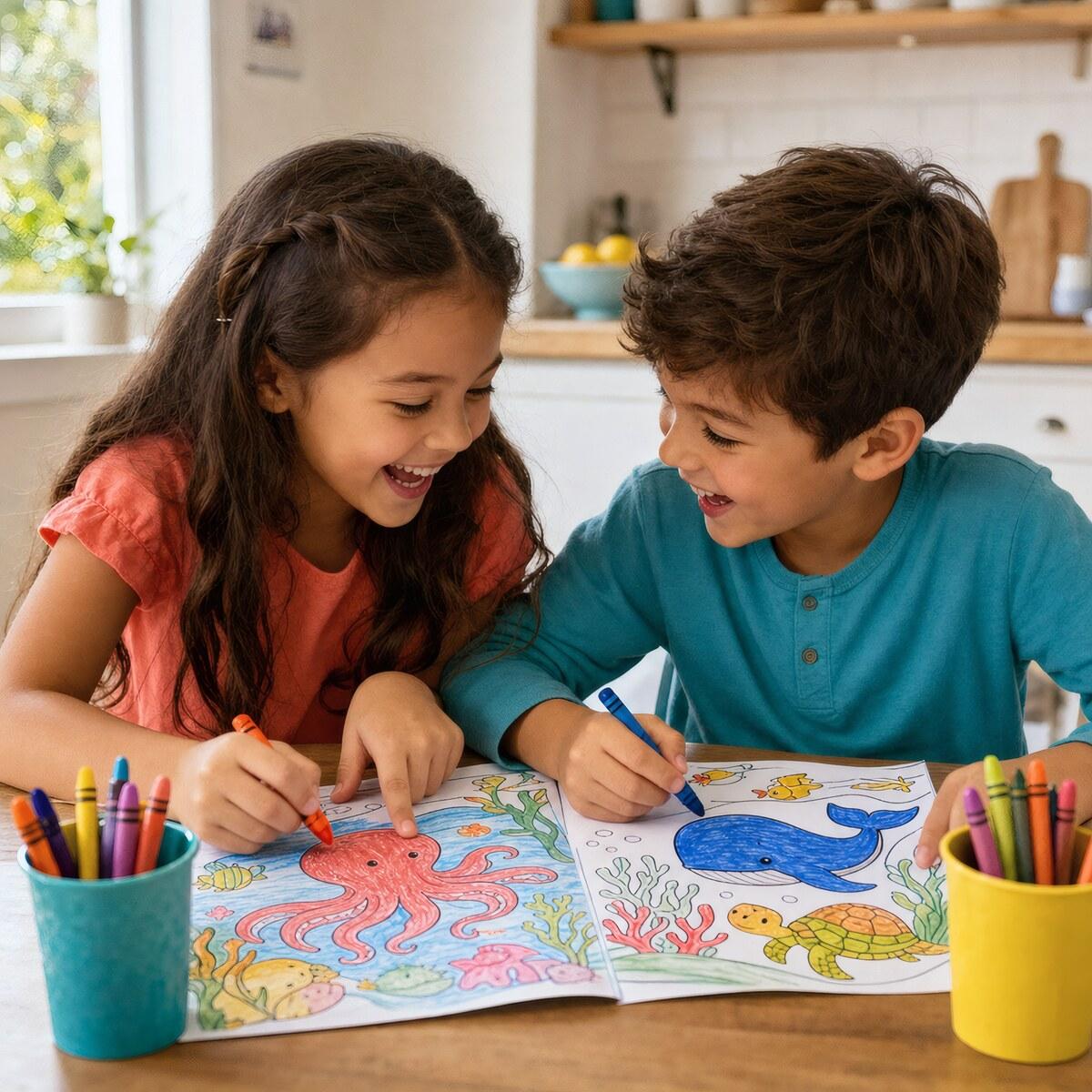
My two kids ruined an entire Saturday morning over a green marker. Not even a good one, either. A slightly dried-out green that neither of them even likes all that much once they've actually got it in hand. That's usually how it goes. The fight's rarely about the thing itself.
Coloring can genuinely build something between siblings, but only if three things are true first. Both kids can actually contribute something. The roles are obvious before anyone touches a marker. And nobody has to beat the other one to enjoy it. This guide's got seven full activities below, not just seven names tossed out with no instructions attached — each one comes with a setup, an age-gap adjustment, the usual conflict risk, and a stopping rule that actually holds up under pressure.
Start with separate pages if the kids are already cranky. Move to shared-page games once they've proven a handoff won't end in tears.
Where do I actually start?
Depends entirely on what's happening in the room right now, honestly.
| Your situation | Start with | Time | Conflict risk |
|---|---|---|---|
| Kids are tired or already bickering | Same theme, separate pages | 10 to 15 minutes | Lowest |
| One child wants control of every choice | Page picker and palette picker | 10 minutes | Low |
| There is a large age or skill gap | Three-color team challenge | 10 to 20 minutes | Low |
| Both kids want the same picture | Split-territory coloring | 10 to 15 minutes | Medium |
| One tablet must serve two kids | Timed sibling swap | 3 to 8 minutes per turn | Medium |
| Kids finish quickly and need a second phase | Make a story together | 5 to 10 extra minutes | Low |
| Comparison starts after the pages are done | Two-detail gallery | 2 minutes | Low |
If you only do three things: give each child a defined job, let a timer handle turn length, and end with the same save-and-stop rule every single time.
Why sibling activities turn into fights
Coloring fights look personal on the surface. The actual trigger's almost always logistical.
The turn is undefined. One kid thinks a turn ends when they feel done. The other thinks it should've ended three minutes ago, and now they're negotiating a timeline nobody actually agreed to.
Every choice stays open at once, too. Page, palette, tool, first turn, all up for grabs simultaneously before anyone's drawn a single line.
A mark on shared paper can't be undone. So one wrong color becomes a much bigger deal than the color itself ever was, and things escalate from there fast.
The activity quietly favors one child. Tiny regions reward whoever's older and steadier with a pencil. One shared stylus rewards whoever grabs it first, which is rarely fair and almost never intentional on anyone's part.
And then there's the parent-as-scorekeeper problem. The kids stop solving anything themselves and start building a case to present to you instead.
The American Academy of Pediatrics generally recommends letting kids take turns choosing shared activities rather than repeatedly favoring whichever one's younger or less mature, and notes that how much an adult should step in depends on age and maturity. The Child Mind Institute makes a similar point in its own sibling-conflict guidance — find the repeating trigger, then build a predictable plan around it before the next blowup happens.
That's the logic behind everything below. The activities are creative. The boundaries are boring on purpose.
The 60-second no-fight setup
You need less gear than it feels like.
- two pages, or one page with sections already assigned
- A color set per kid, when that's actually possible.
- one visible timer, something they can watch count down themselves
- A folder for pages that don't get finished, or a device that saves progress automatically.
- enough table space that elbows aren't fighting for territory before the markers even do
Seat kids at adjacent corners of a table instead of dead shoulder-to-shoulder if poking and crowding keep coming up. For one shared device, settle the first two jobs before the page even opens — one kid picks the picture, the other colors first. Swap those next time around.
Say the whole rule in one breath, before anything starts:
"One job each, the timer decides turns, nobody fixes somebody else's part, and when it beeps we save and stop."
Rules announced after a fight sound like a verdict. Rules announced before the activity are just how the game works, and kids generally accept that difference more easily than parents expect.
1. Same theme, separate pages
Best for — first attempts, tired kids, perfectionists, or any day a shared page is asking for more than anyone's got left.
Let the kids agree on one category together, then hand each a different page from it. They're working in the same world without fighting over the same patch of sky.
Vary the detail level inside one theme:
- Dinosaurs: smiling T-rex for big friendly shapes and dinosaur volcano if one kid wants more detail.
- Space: rocket launch has one clear subject; planets parade suits a kid who likes smaller regions.
- Ocean: whale splash for the younger artist, coral reef for the one who wants to be there a while.






The shared task here is choosing the theme together. The individual task is finishing whatever the timer allows, at whatever pace each kid actually moves. Don't make them match speed or finish together. Judge region size before you print: big open shapes for the younger kid, denser lines for the older one, and the easy pages tier covers the little one reliably.
2. Page picker and palette picker
Best for — two kids who both want the power to decide something.
One child picks the page. The other picks a palette of three to five colors. The page picker doesn't get to reject the palette once it's chosen, and the palette picker doesn't get to reopen the page search. Swap the jobs next time.
For a big age gap, let the younger one choose from two pages you've already picked out instead of the whole library — my older kid used to hold the entire family hostage over which page to open, so trimming that list down for the little one actually saved real time, not just arguments. Let the older child build the palette, three or four colors, final say theirs. Both choices stay real. Neither one turns into an endless scroll.
Works especially well on paper, since you can just print two copies of the chosen page. On one device, set up two separate turns and let each kid use the shared palette on their own saved version.
3. The three-color team challenge
Best for — siblings at different skill levels who still want one shared rule between them.
Together, pick exactly three colors. Each kid gets a separate page and has to reuse those three colors however they want. A green sky's legal. So is a purple dinosaur, honestly, go for it.
- Put six candidate colors on the table.
- Each child protects one color from getting cut.
- Pick the third color together, or draw it at random if they can't agree.
- Set a 10-minute timer and start both pages at once.
At the end, ask one neutral question. "Where'd you use the same color differently?" Don't ask which page is better — that's not the point here. The point's noticing two different solutions to the same limit.
4. Split-territory coloring
Best for — kids who genuinely want to make one picture together and can respect a boundary they can't see with their own eyes.
Pick a page with obvious sections. Assign the territory before the first mark goes down.
- character and background
- Sky and ground, if the page has a clear horizon.
- large shapes versus small details
- Left half, right half. The simplest split when nothing else fits the page.
On paper, draw a light pencil line if the sections aren't obvious enough on their own. Digitally, name the regions instead of splitting by half, since fill tools work by enclosed area anyway: "You take the rocket and flames, I'll take the planets and sky."
Give each kid veto power inside their own territory. Nobody recolors or "fixes" the other section, ever. If they can't agree on a final palette, hand them a ready-made one and remove that fight from the table entirely.
This is the hardest activity on this whole list, skill-wise. It falls apart pretty often under age five, and that's not a character flaw in anyone. Go back to separate pages and try again in a few months.
5. The timed sibling swap
Best for — one tablet, one special marker nobody else has, or kids who actually like building on each other's ideas.
Match the turn length to whichever kid is youngest.
| Youngest child's age | First turn length | Warning |
|---|---|---|
| 3 to 5 | 3 to 5 minutes | 1 minute |
| 6 to 8 | 5 to 8 minutes | 1 minute |
| 9 and older | 8 to 12 minutes | 2 minutes |
The next artist can add to a turn. They can't erase it, cross it out, or "repair" it, full stop. On Coloring Dojo, hit save and resume before every handoff so a swap can't accidentally wipe out progress.
Keep the actual handoff plain. Save, name the next artist, reset the timer. That's it. Commentary about the last person's choices is exactly where a neutral swap turns into a critique nobody asked for.
6. Make a story together
Best for — kids who finish coloring at different speeds, or want a second activity without pulling out more supplies.
Once the pages are done, build a six-sentence story together. Child A says sentence one, Child B says sentence two, alternating through to six. A parent can write it down for younger kids without changing their actual words.
If the first sentence stalls out, try one of these:
- Who lives in this picture?
- What happened five minutes before this scene?
- What's hidden just outside the frame?
- What problem do the characters solve together, if any?
For an early reader, point at three objects on the page and ask them to work all three into the story somehow.
7. The two-detail gallery
Best for — ending without declaring a winner, especially with a kid who tends to compare finished pages against each other.
Put the pictures side by side. Each kid names two specific details they like on the other's page. "I like it" doesn't count, too vague to mean anything. "I like the yellow dots on the rocket" actually gives the sibling something real to hold onto.
If spoken compliments start turning into backhanded jabs, switch to two stickers per kid instead. Each one silently sticks a sticker beside two details on the other's page. No ranking, no parent weighing in, no best picture declared. I'll admit I lean on stickers more than compliments these days, no real research behind that preference, just years of watching which one actually stays kind.
Then display both pages together, or drop them in the same folder. The shared ending matters about as much as the shared start did.
Paper, two devices, or one shared device?
| Setup | What it solves | What can still go wrong | Best activity |
|---|---|---|---|
| One printed page per child | Removes turn and undo conflicts | Marker ownership and comparison | Same theme, separate pages |
| Two devices | Gives full independence | Page-choice browsing can drag on | Three-color challenge |
| One shared device | No supply cleanup | Turn disputes and unwanted recoloring | Timed sibling swap |
| One shared paper page | Creates one joint result | Mistakes are permanent | Split territory |
Paper's the lowest-conflict option when everyone's already running on empty. A shared device gets a lot easier once progress saves and bad fills can be undone. A shared paper page asks for the most self-control out of any option here, so treat it as the advanced level, not the default one.
Adjusting for a big age gap
Don't make the older kid a permanent assistant. That just hands the younger one the fun job and the older one unpaid supervision duty.
Vary the page instead, and keep both kids' status equal.
- Ages 3 and 8: same theme, big regions for the three-year-old, a detail page for the eight-year-old.
- Ages 5 and 10, younger picks the page, older builds the palette, then swap next time.
- Ages 7 and 12: shared story after separate pages, younger picks the characters, older does the writing.
- Three or more kids: separate printed pages, a visible turn order posted somewhere for any shared tool, and turns short enough that nobody's stuck just watching.
The useful question isn't how to make this fair exactly. It's what gives each kid real ownership at their own level. Equal time can work. Different pages can too.
When a fight starts anyway
No activity can fix a conflict that's already gone unsafe. Hitting, threatening, a kid who can't stay in control, any of that means stop and separate first. The AAP guidance mentioned earlier recommends stepping in as a calm, neutral adult once kids can't resolve it themselves or someone's safety is actually at risk.
For a verbal dispute that's still contained, though:
- Stop the timer.
- Name the actual problem without guessing at motive. "You both reached for the tablet before the timer went off."
- Restate the rule that already exists. "The timer decides the handoff, that's the deal."
- Ask for one workable next step. Resume the turn, switch to separate pages, or call it for today.
Don't hold court at the table over who started it. If you need the full story, talk to each kid separately once everyone's calm again.
The fights that keep repeating
"They keep changing pages"
Pick one category for the session, give sixty seconds to choose, allow a single reroll on random, then close the choice for good. If browsing keeps eating the whole session, the fast page-picking guide has a quicker method.
"One kid copies everything"
Hand out different prompts inside the same theme. One colors a daytime version, the other does night. One sticks to warm colors, the other cool. Copying loses most of its appeal once the assignments are already different from the start.
"One kid keeps correcting the other"
Go back to separate pages. If you try a shared one again later, use explicit territory and make "no fixing" the very first rule stated out loud. A kid who can't leave someone else's section alone just isn't ready for the shared version yet, and that's fine.
"One kid finishes way early"
Decide the second task before starting, not after someone's already bored. Add a background pattern, name the picture, or start the story activity. A bored finisher hovering over a focused sibling is about as predictable a source of trouble as this list has.
"They fight over the same exact color"
Split a basic color set into two small cups, even if the actual shades don't match perfectly, or switch to the palette-picker activity instead. For one marker that can't be duplicated, put it on the same timer system as the tablet.
"The timer makes the handoff worse, somehow"
Shorten the first turn and add a one-minute warning before it ends. A cold handoff feels like something got taken away without warning. A warned one feels like the rule everybody already agreed to.
From experience: we switched to hard timer endings instead of waiting for both kids to feel finished. The "but I'm not done" protests faded out after about a week, mostly because the ending stopped shifting from one session to the next. Unfinished pages always went into the same tomorrow folder, no exceptions.
A printable setup checklist
- Choose one theme before the kids sit down.
- Match each page to the child's actual skill, not just their age.
- Give each child one clear job, or their own page entirely.
- Put shared tools somewhere both kids can reach without stretching.
- Set the timer and say the warning time out loud.
- State the no-fixing rule before anyone starts coloring.
- Decide where unfinished pages go.
- End with a story, the two-detail gallery, or the same closing line every time.
Frequently asked questions
What are the best sibling bonding activities for kids who fight a lot?
Start parallel. One shared theme, separate pages each. It builds a common experience without needing turns, shared territory, or matching skill levels. Add the shared-page games only once they've gotten through a few low-conflict sessions first.
Should siblings always be made to play together?
No, not really. Time together builds something real, sure, but kids also need their own space and their own one-on-one time with a parent. The AAP specifically recommends individual time alongside the group stuff. A kid who asks for space shouldn't have to earn it by finishing some bonding activity first.
How do you make this fair across different ages?
Keep the theme the same, vary the difficulty. Bigger regions for the younger kid, more detail for the older one, then give both equal ownership through roles, turn order, or the shared story at the end. Fair doesn't have to mean identical, at least not in my experience.
Are competitive games good for sibling bonding?
Sometimes, but only once both kids can already handle that particular game without it turning into a courtroom. If competition reliably fuels comparison or accusations between them, go cooperative or parallel instead. Understood's sibling guidance makes a similar point, that activities should fit both kids' actual strengths rather than forcing a format that doesn't.
What if one sibling just refuses to join in?
Don't turn bonding into a punishment, that backfires fast. Offer two low-pressure options instead, separate pages at the same table or one short story after coloring, and accept it if the answer's still no. A repeatable ten-minute ritual beats one forced hour every time.
When does this need actual professional help instead?
Talk to your pediatrician or a qualified family therapist if the conflict regularly includes injury, intimidation, cruelty, or fear that the family genuinely can't manage safely on its own. A coloring setup handles ordinary friction. It's not built for, and shouldn't be treated as, a response to abuse.
Today's easiest version: pick one category from all coloring pages, open two different pages, set ten minutes, and end with one specific thing each kid likes about the other's picture.