My daughter once threw a shoe at my head over a broken cracker. Not a broken plate, not an actual injury. A cracker that split into two slightly uneven halves. I remember standing there thinking the problem clearly wasn't the cracker, and also having zero idea what the actual problem was.
Turns out the activity has to match what's happening in the body, not the size of the trigger. A kid who's physically revved up needs slow movement before anyone asks them to sit still. A worried kid needs connection and breathing they can predict. A hungry, exhausted, or just plain overwhelmed kid needs a basic need met. Not an activity at all, honestly, no matter how good the activity is.
Start by lowering your own voice. Make the space feel safe. Use fewer words than you think you need. Then offer one activity, not a menu of twelve laid out like a buffet. Hand-tracing breaths, wall pushes, slow stretches, a simple coloring page, quiet music, a calm corner, any of it can help. None of it works for every kid, or even the same kid every time.
Quick reset: get low enough to be seen without crowding them. Say, "You're safe. I'm here. First water, then three slow pushes, then we choose what's next." Do the movement together. Wait before adding another instruction on top.
Calm isn't instant obedience, worth saying plainly. The goal's helping a kid get back to enough regulation for connection and the next safe step. Not erasing the anger or the disappointment or the tears entirely, since those were never really the problem to begin with.
Matching the activity to what's actually going on
Look for the dominant need first. Guess wrong and the activity creates more resistance? Stop. Simplify further than you think is necessary.
| What you see | What may help first | Skip for now |
|---|---|---|
| Running, crashing, very loud voice | Slow heavy movement, wall pushes, stretching | Demanding a chair immediately |
| Crying after a mistake or loss | Connection, water, feeling picture, then a simple task | Lectures and game analysis |
| Worry, clinginess, rapid questions | Predictable breathing, a short script, quiet proximity | "There's nothing to worry about" |
| Covering ears, hiding, avoiding touch | Reduce noise/light, offer a calm corner, fewer words | Forced eye contact or touch |
| Tired, hungry, hot, or thirsty | Meet the physical need | Turning distress into a behavior lesson |
| Angry and unsafe with hands or objects | Create space and block harm calmly | Small loose materials |
| Quiet but stuck after an upset | Drawing, coloring, music, or a simple sensory tool | Repeatedly asking "Are you calm yet?" |
Behavior usually has more than one cause anyway. A preschooler right after soccer might be hot, disappointed, hungry, and overstimulated, all at once, and good luck sorting which one's driving the bus. You don't need the perfect label before helping. Meet the obvious physical stuff first and lower the demands around them.
Before any activity: connect, protect, reduce
Work in this order.
- Protect. Move breakable stuff, put distance between kids if there's more than one, block hitting or running into danger as calmly as your body allows.
- Connect. One short acknowledgment covers it. "That was hard," or "You wanted another turn."
- Reduce. Noise down, lights down, fewer questions, smaller audience if people are watching.
- Offer. One familiar calming action, not a lineup of options.
- Wait. Give the nervous system time to actually respond before stacking on a second strategy.
You don't have to feel perfectly calm yourself to pull this off. Speaking slower and cutting a five-sentence explanation down to one sentence is already doing real co-regulation work, even if your own heart's still racing a little.
12 activities, taught before they're needed
Teach these during neutral moments, ideally when nobody's upset at all. A strategy introduced for the first time at peak distress is a much harder sell.
1. Hand-tracing breaths
Best for — worry, waiting, bedtime transitions, or a kid who likes having visual steps to follow.
- Hold one hand open like a star.
- Trace up the thumb with the other index finger while breathing in.
- Trace back down while breathing out.
- Keep going around all five fingers.
Don't push for an unusually deep breath or an exact count, that's missing the point. Slower and more comfortable is enough on its own. If breathing exercises make a kid more anxious or dizzy, stop and switch to something else entirely.
2. Pinwheel or bubble breathing
Best for — kids who don't really get what "take a deep breath" even means yet.
Use a pinwheel and ask for a long gentle blow that keeps it spinning, or blow bubbles slowly and just watch where they land. The object makes an invisible exhale visible, which does a lot of the work.
Stick to age-appropriate, non-toxic bubble solution, supervised. Don't let anyone drink it or share mouthpieces, and skip anything with small detachable parts if the kid still mouths objects.
3. Wall pushes
Best for — a body that wants to crash into something, push, or run.
- Stand an arm's length from a clear wall.
- Both palms flat against it.
- Push slowly for a count of five.
- Rest, shake the hands out, repeat three times total.
Call it "make the wall strong" instead of framing it as exercise, kids respond better to that somehow. Stop for pain, dizziness, or discomfort, and only use movements that actually fit the kid's abilities.
4. Slow animal movements
Best for — post-play energy, and kids who can't shift straight into sitting still yet.
Pick one slow movement. Bear-walk across the room. Turtle-crawl to a cushion. Reach tall like a giraffe, then fold small like a mouse. Keep it controlled and brief, since racing animals just raises the energy right back up again.
Clear the floor, supervise, skip anything a clinician's advised against for that specific kid.
5. Three-part stretch
Best for — right after sports, recess, dancing, or any loud active play session.
Three movements, together.
- Reach overhead for one comfortable breath.
- Roll shoulders slowly, three times.
- Sit or stand and shake arms and legs out gently.
It's a transition, not a flexibility test. Bouncing, painful holds, competitive stretching, none of that belongs anywhere near a calming routine.
6. Color one small section
Best for — a kid whose energy's already dropped enough to sit and use materials safely.
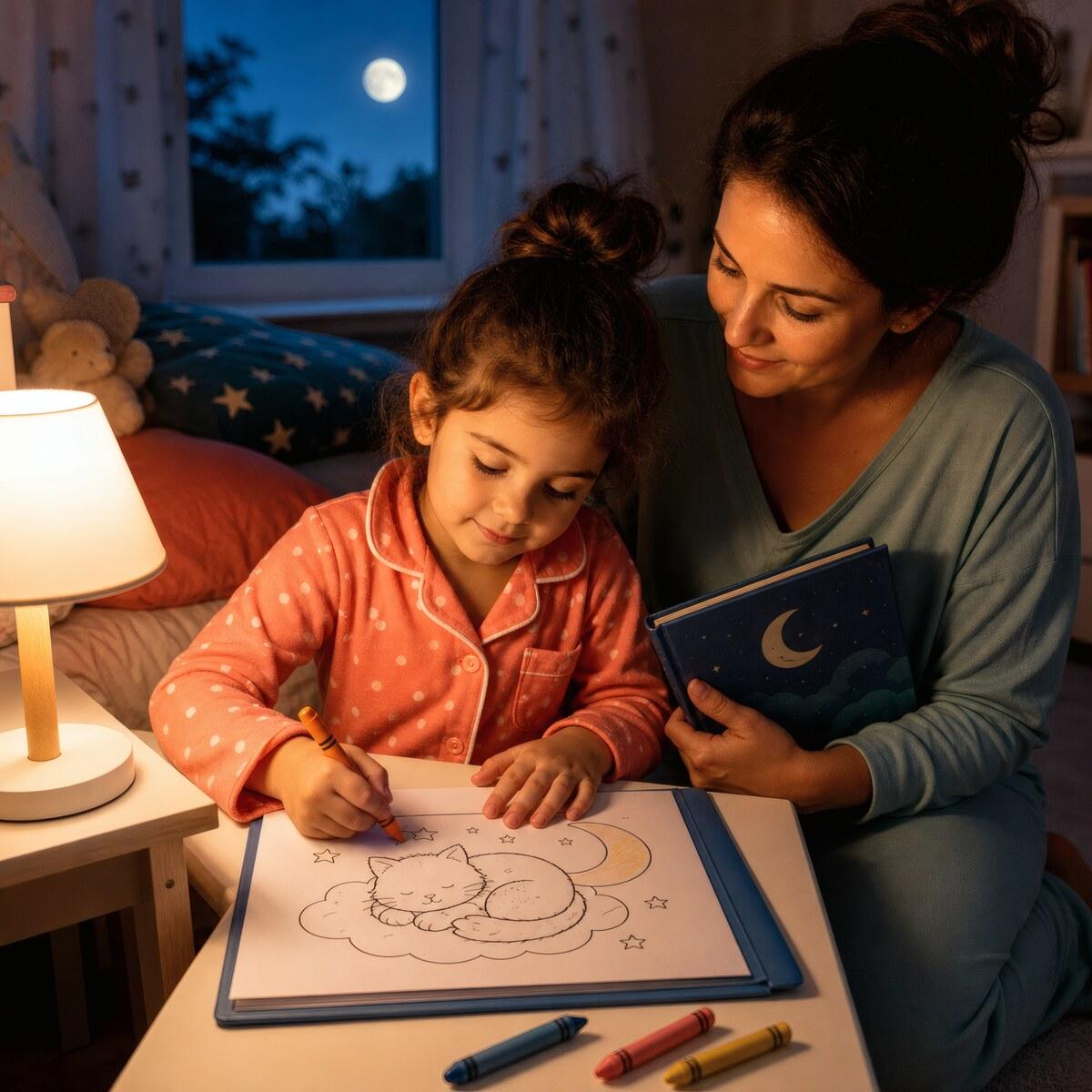
Don't hand over a detailed page and say "go calm down," that's setting the activity up to fail. Prepare one simple page and three crayons instead. Point to a single section, set a 6- to 8-minute timer, and say something like "you can color this part while I sit nearby."
Coloring helps some kids because it gives their hands a predictable, low-stakes job to do. It frustrates others, especially when a mistake or an unfinished picture feels genuinely intolerable to them. It's one option among several, not a universal fix.
Use a page with large regions, an animal or weather page works well. If the kid keeps quitting over tiny details, go a size simpler; the easy pages exist for exactly this moment.
7. Draw the feeling as weather
Best for — kids who can draw but really don't want to answer questions right now.
Ask, "if this feeling were weather, what would it look like?" They might draw lightning. Fog. Wind, or a tiny drizzle that barely counts as rain. Don't interpret the picture for them. You can ask "tell me about this part" or just sit there quietly instead.
This is expression, not diagnosis, worth remembering. A dark picture doesn't prove some specific emotional problem exists, and the kid doesn't owe anybody an explanation for what they drew.
8. A five-senses grounding hunt
Best for — mild worry, waiting rooms, travel days, or a kid who likes noticing games generally.
Keep it short for preschoolers specifically.
- find three things you can see
- find two sounds you can hear
- find one thing your hands can feel
Skip taste and smell prompts in an unfamiliar space, for obvious reasons. If the questions themselves add to the overload, just quietly name one neutral detail yourself. "I see a blue chair" is plenty.
9. Make a calm corner
Best for — overwhelm that keeps recurring, at home or in a classroom.
A calm corner can be a chair, a floor cushion, or a small uncluttered area with a feelings card, two books, paper, and one sensory tool. It doesn't need a tent or expensive furniture. A hand-lettered sign isn't required either, honestly, though plenty of Pinterest boards will tell you otherwise.
Introduce it while the kid's calm. Let them practice going in and coming back out on their own. Never lock it, block it, or use it as punishment. A calm corner's a regulation option, not isolation dressed up for being inconvenient to deal with.
10. Listen and sway
Best for — a kid who responds well to rhythm and closeness.
Pick one familiar quiet song. Sway together, rock in a safe chair, tap out a slow beat, or just sit side by side without touching. Ask before touching a kid who's avoiding contact right now. Some kids settle right into music. Others need silence instead, so watch what actually happens rather than assuming "calming music" is calming for every single kid on the planet.
11. Offer one sensory object
Best for — waiting, or a kid who already uses a particular tool successfully elsewhere.
Offer one item. A soft fabric square, a squeeze ball, a firm pillow to hug, a sealed sensory bottle. Too many objects just becomes another stimulating choice to sort through, which defeats the purpose.
Inspect everything for damage and choking hazards regularly. Skip homemade mixtures, essential oils, weighted products, or anything meant for the mouth unless you actually understand the risks, and ideally have guidance from an occupational therapist where that applies.
12. Reconnect and repair
Best for — after the body's slowed down, especially following an actual conflict between people.
Calming isn't where the interaction ends. Reconnect with a short sequence afterward.
- Name what happened, no blame attached. "The game ended and you threw the bottle."
- Acknowledge the feeling underneath it. "You were really disappointed."
- Restate the limit plainly. "I won't let bottles get thrown."
- Repair one concrete thing. Pick it up, check on someone, try the transition again from scratch.
Repair still has to happen after calming down, that part doesn't go away. Calming's just what makes that conversation possible in the first place, once everyone can actually hear each other again.
A 10-minute plan, when you genuinely don't know where to start
Use a fixed sequence instead of guessing. Works particularly well right after active play or sports, in my experience.
| Minute | Step | Adult words |
|---|---|---|
| 0-1 | Water and quieter space | "First water. I'm right here." |
| 1-3 | Slow stretch or wall pushes | "Three slow pushes together." |
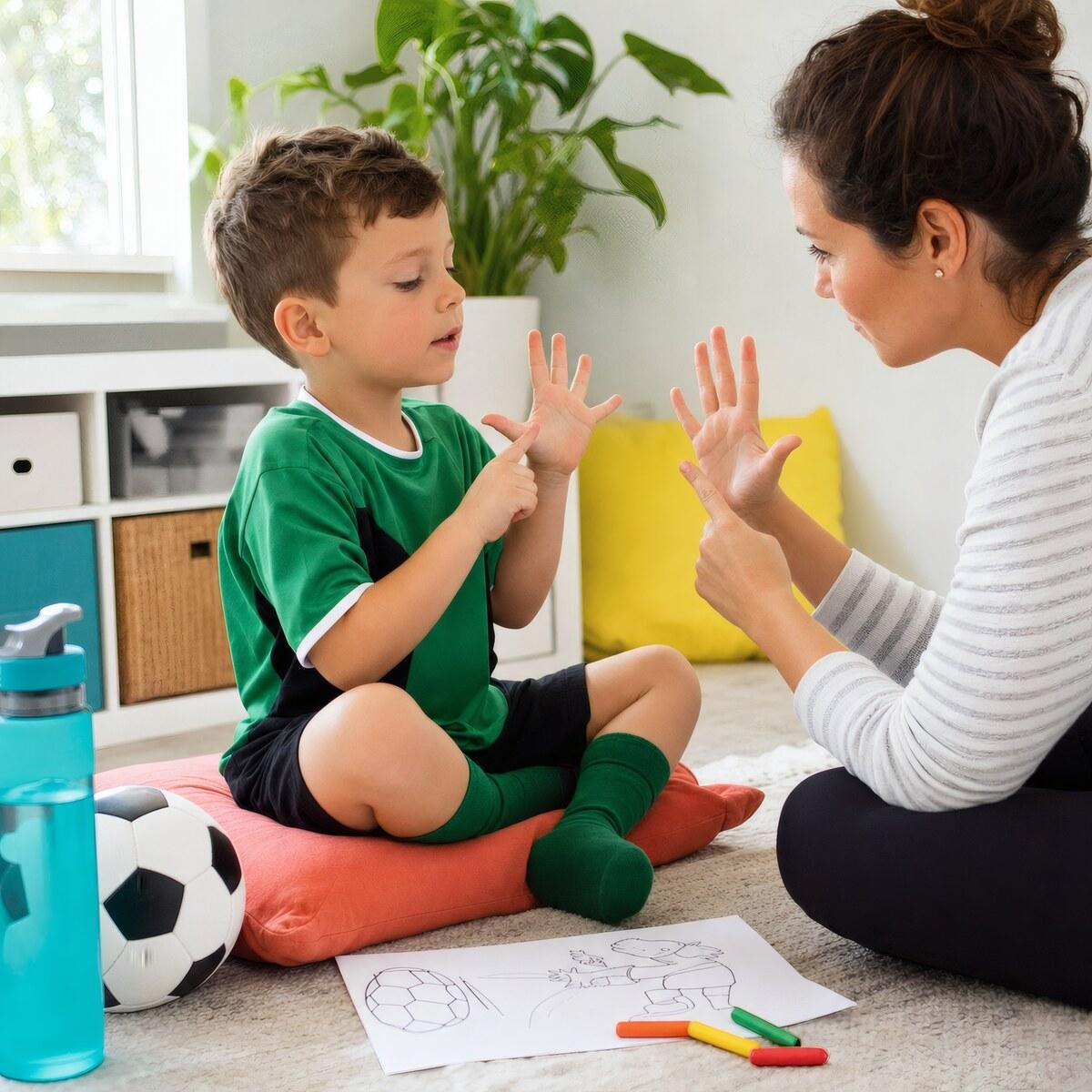
| 3-4 | Hand-tracing breath | "Up we breathe in; down we breathe out." |
| 4-9 | One simple coloring section | "Three colors, this section, then save." |
| 9-10 | Name the next step | "Page in the folder. Next is dinner." |
If the kid refuses the coloring step, just skip it. The sequence is a scaffold. Not a contract everyone signed. Water, slow movement, and a predictable handoff is often already enough on its own.
After sports: tired and wired is its own weird category
A preschooler can leave practice physically exhausted while still talking, moving, and replaying every single moment at full volume the whole ride home. Anyone who's driven back from an early-evening practice knows that particular back-seat smell, sweat and hunger mixed with adrenaline that hasn't quite figured out where to go yet.
The order that tends to work best:
- Water and a planned snack, if that fits. Meet the obvious physical need first, and follow whatever medical or allergy plan applies.
- One or two minutes of slow movement. Stretch or walk instead of demanding instant stillness from a body that's still buzzing.
- Acknowledge the game itself. "You wanted that goal" covers it. Save the coaching for later.
- Color one simple sports page for about 8 minutes. Team colors give an easy starting point if the kid's stuck.
- Move into the same next task as always. Shower, dinner, the ride home, or straight to bedtime.
On days nobody wants to follow an adult through stretches, a short follow-along video can carry the transition instead. Preview the movements yourself first, clear the area, stop if anything hurts.
Sports coloring pages matched to the moment
Go with equipment and large shapes for younger preschoolers specifically. Action scenes tend to pack in smaller limbs, uniforms, and background clutter that trips them up.
| Interest | Page | Easier starting point |
|---|---|---|
| Soccer | Soccer shot | Ball and field |
| Basketball | Basketball hoop | Ball and backboard |
| Baseball or T-ball | Home run swing | Bat and jersey |
| Football | Touchdown | Ball and end zone |
| Swimming | Swim goggles | Two large lenses |
| Any sport | Trophy and medal | Medal ribbon |






Two things we've noticed firsthand shaped this whole setup. Under age five, equipment pages like the goggles are just easier to enter than action poses packed with small regions. And more unexpectedly, the trophy page has started some genuinely good conversations after a loss in our house, kids coloring it have volunteered something that went well without anyone asking for a full post-game breakdown. That's a household observation though, not a promise that a trophy picture fixes every kid's mood.
Making the coloring step calming instead of another demand
Stick to these constraints.
- page chosen before the kid even sits down
- three to five colors, not the whole supply drawer dumped out
- one section, not "finish the picture" as an unspoken expectation
- 6 to 8 minutes, for preschoolers specifically
- no corrections, no color lessons, no pressure to stay inside any lines
- a finish-later folder or digital save at the very end
Prompts that keep the sports connection alive without it turning into homework:
- "Want your team colors, or silly colors instead?"
- "Which part should we color first?"
- "Should the ball have a pattern on it?"
- "Want me right beside you, or a little farther away today?"
If the page triggers a perfectionism spiral, switch to online coloring for easy undo, or just drop coloring from the reset entirely. Handing over just three crayons cuts the choices when color selection's the actual sticking point.
Scripts for the moments that keep repeating
When a kid is yelling
"I hear how upset you are. I'm going to use a quiet voice. We can talk once your body feels safer."
Don't demand they match your volume right away, that's asking too much too fast. Model the pace you're actually offering instead.
When a kid is hitting or throwing
"I won't let you hit. I'm moving this back and giving us some space."
Keep the limit short. Detailed explanations belong after safety's actually back, not during.
After losing a game
"You wanted a different ending. Water first. We can talk about the game later, once you're ready."
Skip "it's only a game" entirely, and hold off on the coaching. Sportsmanship gets learned after a kid's actually been allowed to feel disappointed about something real to them.
When a kid rejects every strategy you offer
"You don't have to choose yet. I'll just sit here quietly."
Sometimes removing the demand altogether is the actual regulating move, more than any specific technique would've been.
When it's time to stop coloring
"Choose one last shape. Then the page goes in the finish-later folder and we've got dinner."
Same warning every single time, no variation. Saving turns the ending into a pause instead of a loss. Digital pages can be saved, downloaded, and printed later if that helps the handoff feel less final.
Practicing when nobody's actually upset
Pick two strategies, not twelve, and practice them for about a week during calm stretches of the day.
- Name the strategy out loud. "This is a hand-tracing breath."
- Demonstrate it yourself first.
- Let the kid try it without correcting every little detail.
- Ask one practical question. "Where should we keep this card?"
- Use the exact same words later, during a mild frustration, and see if it clicks.
A kid might eventually ask for a familiar tool on their own. But independent self-regulation is still a developing skill at this age, and preschoolers need adult support, environmental changes, and a lot of repeated practice before any of this becomes automatic.
A small calm kit worth setting up
Use a lidded box or pouch an adult can inspect easily.
- a laminated hand-breathing card
- four crayons and three simple pages
- one soft fabric square or a sturdy squeeze item
- a feelings or weather card
- a finish-later folder
- a visual card showing what happens next
Don't fill it with tiny trinkets, those just become a choking risk and a distraction both. Check it regularly for leaking, broken, or loose pieces. Store it somewhere the kid can reach and use it safely on their own, not as a prize dangled for good behavior.
Adjusting by place
In the car. Park before leading any activity, don't try this while driving obviously. Offer water, a simple breathing prompt, quiet audio, or one crayon with a clipboard page. Don't ask whoever's driving to coach or manage loose supplies at the same time. Our travel coloring kit keeps the car version genuinely compact.
In a classroom. Use a predictable calm space, a visual return step, and strategies taught to the whole group ahead of time. Avoid announcing to the room that one specific kid "needs to calm down," that's more shame than help. Follow the kid's education, behavior, sensory, or safety plan wherever one already exists.
With siblings. Create physical space first, before anything else. Give each kid separate materials, and reconnect with them individually before attempting any shared repair. The sibling bonding activities guide has structured turns and ways to lower competition during neutral play, if that's the recurring issue.
Before bed. Skip energizing movement entirely and go with lower light, fewer words, a paper page, and a consistent ending every night. The full preschool bedtime routine covers where an optional coloring block fits without pushing lights-out any later than it needs to be.
What commonly backfires
| Approach | Why it can fail | Better alternative |
|---|---|---|
| "Calm down!" repeated loudly | Gives no usable action | Name one concrete next step |
| Offering ten choices | Adds decision load | Offer one activity or two at most |
| Forced deep breathing | Can feel controlling or uncomfortable | Model a gentle exhale; allow refusal |
| Calm corner used as timeout | Makes the tool feel punitive | Practice voluntary use when calm |
| Asking for an apology immediately | Demands language before regulation | Repair after the child can reconnect |
| Detailed processing at peak distress | Adds cognitive load | Use one acknowledgment; talk later |
| Coloring page that is too hard | Adds frustration | Use large regions or one small section |
| Adult touching without asking | Can increase sensory distress | Offer proximity and request consent |
When activities just aren't enough
Get immediate help if a kid's in danger, can't be kept safe, is having trouble breathing, loses consciousness, or shows any other urgent medical symptom. Use your local emergency service or crisis line, whichever fits the moment.
Talk to the kid's pediatrician, teacher, counselor, or occupational therapist when intense distress shows up often, drags on a long time, regularly wrecks sleep or preschool, causes injury or real property damage, or marks a sudden shift from how that kid usually behaves. Ask for guidance too if sensory responses, anxiety, aggression, or sleep trouble are limiting everyday life more than they used to.
This piece offers general activities. It isn't a diagnosis, and it isn't an individualized behavior, mental-health, or occupational-therapy plan for your specific kid.
Calm-down checklist
- Check safety and obvious physical needs
- Lower your voice and reduce the number of words
- Move spectators, noise, or bright input away
- Acknowledge the feeling without debating it
- Offer one familiar activity
- Allow the child to refuse nonessential touch
- Wait before adding another strategy
- Reconnect and repair after the body slows
- Note what helped without judging the child
- Practice the same tool later during a calm moment
Frequently asked questions
What calms a preschooler down quickly?
There's no guaranteed instant technique, unfortunately. Address safety, hunger, thirst, heat, fatigue, pain, and sensory overload first. Then try one familiar tool, slow movement, hand-tracing breaths, quiet proximity, or a simple repetitive activity.
How do I calm an overstimulated preschooler?
Cut the input down. Move to a quieter space, lower the lights, stop asking questions, skip unexpected touch, and offer one familiar comfort or visual cue. Some kids want you close. Others need more physical space than you'd guess.
Is a calm corner just a rebranded timeout?
It shouldn't be, and if it is, it's not doing its actual job. A calm corner is a taught, accessible place for regulation that a kid can use voluntarily. It should never be locked, blocked, used to shame, or withheld as punishment.
Does coloring actually help kids calm down?
For some kids, yes, it gives their hands a predictable job once their energy's already started dropping. It can frustrate kids who dislike coloring, fear mistakes, or feel like they have to finish. Watch how your specific kid responds rather than assuming it'll work.
What should go in a calm-down kit?
Keep it small. A breathing card, a few crayons, simple paper, one safe sensory object, a feelings card, a visual next-step card. Skip choking hazards, leaking homemade items, and scented products that might trigger sensitivities in some kids.
Should I talk about the behavior right away, while it's fresh?
Handle immediate safety with very few words first. Save the teaching, the problem-solving, the apology, and any consequences for once the kid can actually listen and reconnect. Calming down doesn't erase the need for that conversation. It's just what makes having it possible at all.
The goal was never a perfectly quiet kid. It's a safe path back from a hard moment to connection, nothing more dramatic than that.