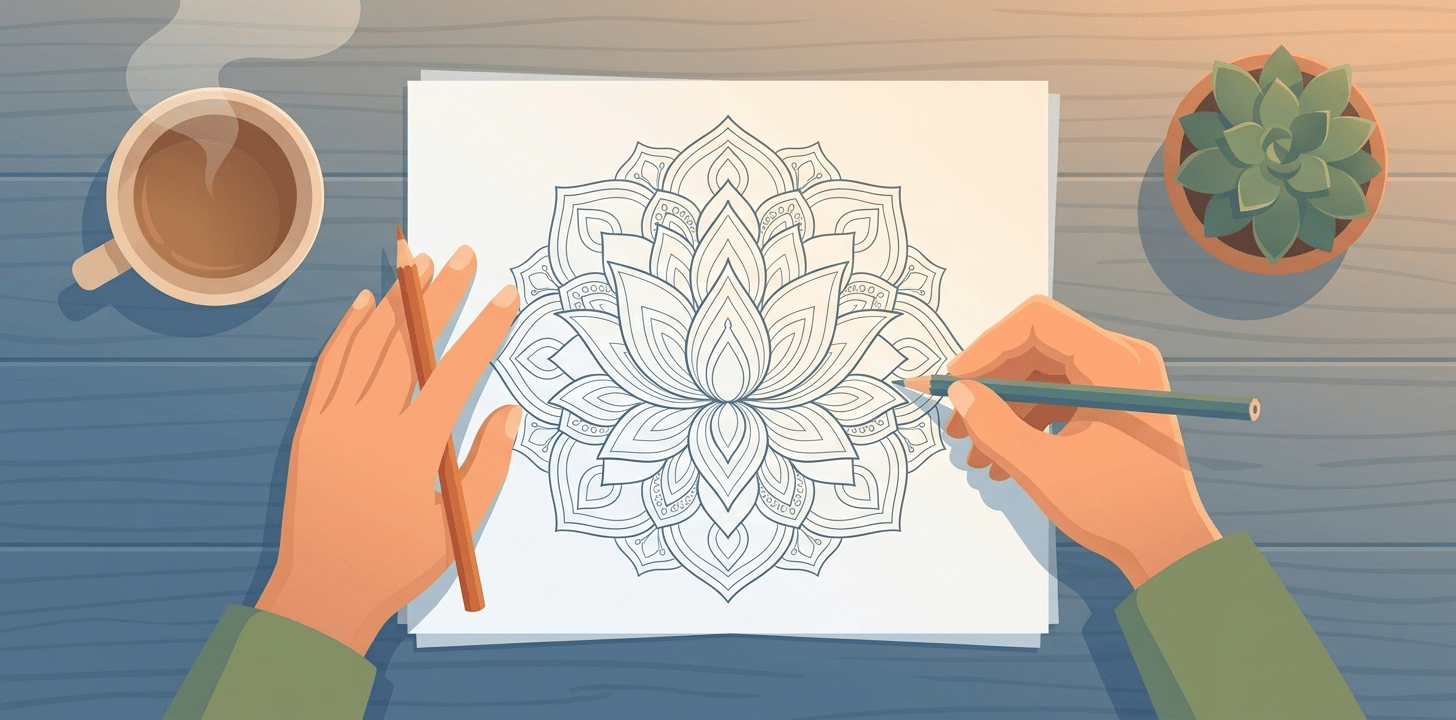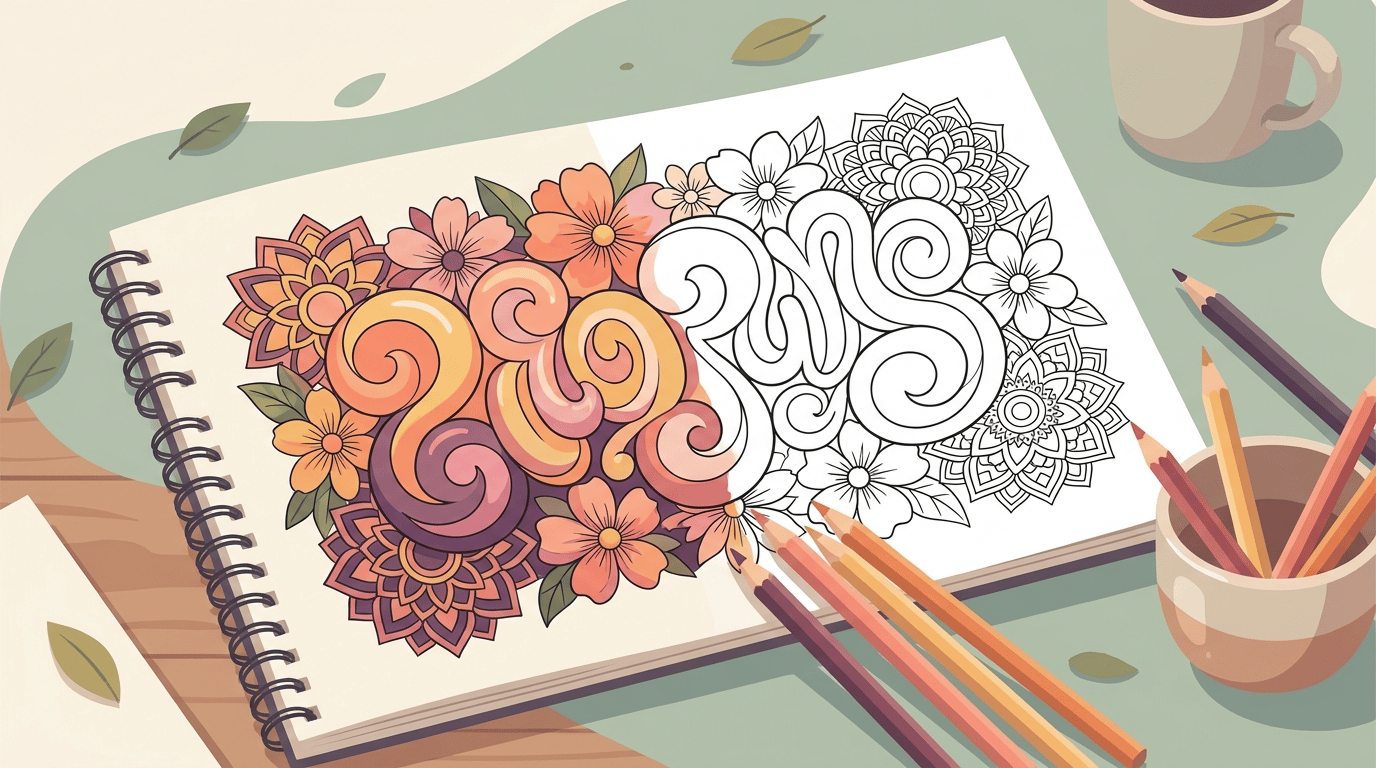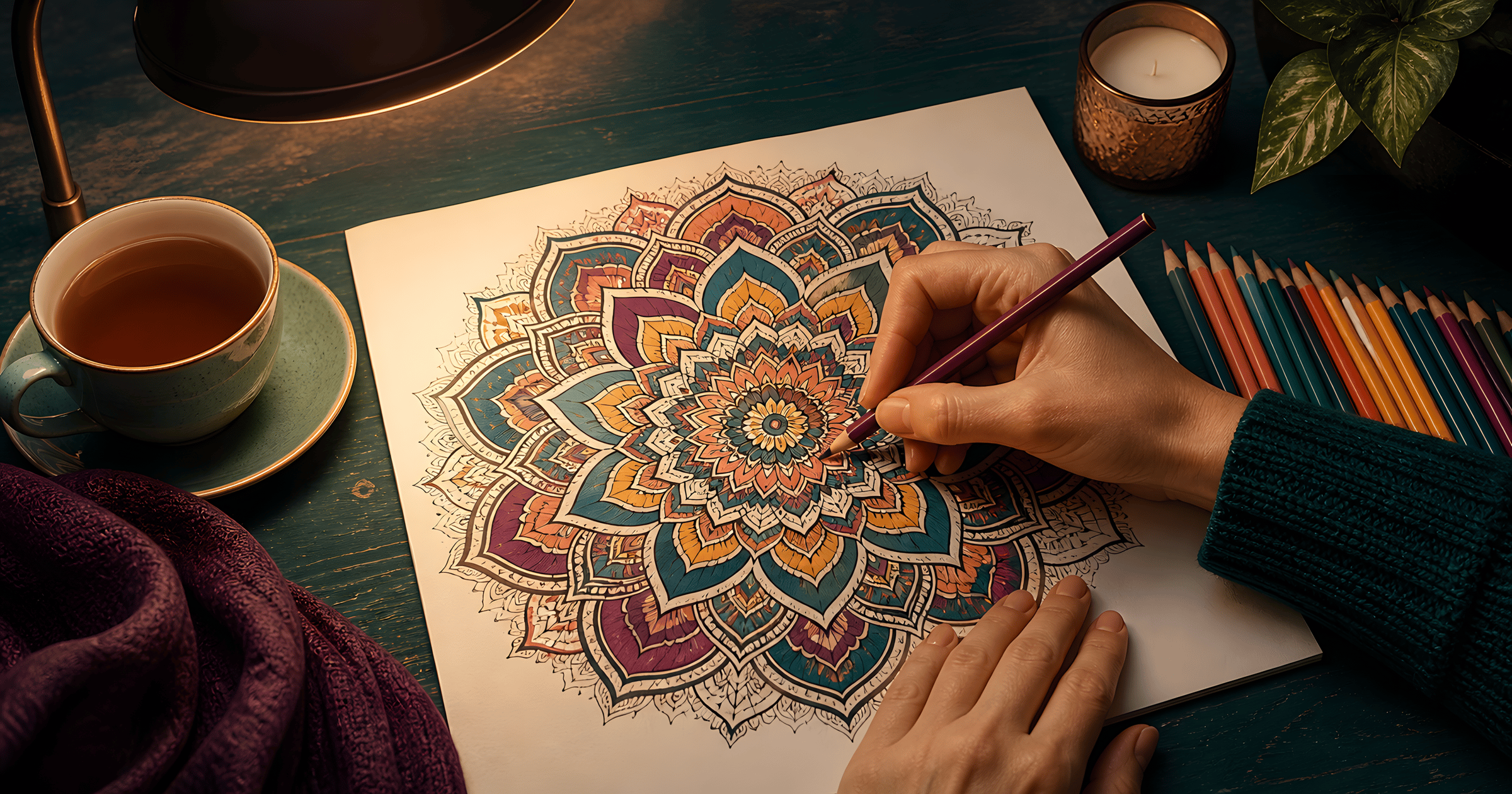
I started coloring by accident. One night after the kids were in bed I was sick of my phone but too wired to just sit on the couch. Grabbed one of the coloring books we had lying around the house, found some of my daughter's pencils in a drawer, colored half a mandala, and went to bed earlier than I had in weeks.
I still color most nights. Usually around fifteen minutes. I don't think it's changed my life or anything but I do notice I fall asleep faster on nights when I color versus nights when I scroll until my eyes hurt. As a low-effort thing to do with your hands at the end of the day, coloring has stuck around longer than journaling or meditation or any of the other stuff I've tried.
The short version
Coloring helps most with winding down after a long day and filling those in-between moments where you'd otherwise grab your phone. Before bed, between tasks, that sort of thing. Most people who try it for a couple of weeks notice the days they color feel a little calmer than the days they don't. Ten minutes with simple pages and a set of colored pencils. That's all you need to test it.
What's going on in your brain when you color
Carl Jung was having his patients color mandalas in the early 1900s. Thought it helped people settle down. Nobody took him that seriously on this particular point for a long time, but the research eventually came around.
Here's what seems to happen. When you sit down to color, both sides of your brain get pulled in. The left side is doing the spatial work, staying in the lines, planning which section to fill next. The right side is picking colors, making those little creative calls. And because none of this is high-stakes, your amygdala, the part that keeps you on edge, gets to stand down for a bit.
Dr. Scott Bea at Cleveland Clinic is a clinical psychologist who's written about this. He compares coloring to mowing the lawn or going for a long drive. Activities where your hands are occupied and your attention narrows to one thing. The chatter slows down. Not because you've solved anything, but because you're not feeding it.
Stress relief (though not the way I expected)
I figured coloring would feel like meditation. It doesn't. Meditation is about sitting with whatever comes up. Coloring is more like... turning away from it for a while. Giving your brain something else to chew on. I find meditation harder, honestly. Coloring I can do on a bad day without it feeling like work.
There's a 2020 study where researchers gave 120 older adults three different activities: mandala coloring, reading, and free drawing. Twenty minutes each. The coloring group reported feeling noticeably more relaxed than the other two. And separate from that, a group of 104 university students who colored daily for a week reported feeling calmer and more settled than a group doing logic puzzles. I don't want to oversell what two studies prove, but it lines up with what most people say anecdotally.
What I notice most is that coloring acts like a palate cleanser. I do it after a noisy day and it's like hitting a soft reset. Not because anything magical happens, but because for those ten or fifteen minutes I'm making simple decisions about color and my brain gets a break from making hard ones.
How to make this work for you: pick pages with larger shapes and fewer tiny regions. Set a timer for 10 to 20 minutes. And stop while you still feel good. Grinding through a page until you're tired of it defeats the purpose.
Focus and the warm-up trick
This one surprised me. On days when I can't settle into work, I'll color for eight or ten minutes first. Something about the focused-but-easy nature of it gets my brain into gear. Then I close the coloring book and open whatever I've been avoiding. The transition into work is smoother than going from phone to laptop.
Researchers who study flow state have a theory for why this works. Coloring is absorbing enough to pull you into the present moment but not demanding enough to cause stress. That absorption carries forward. You've already warmed up the part of your brain that concentrates, so the next task feels less daunting.
If you want to explore this more, our post on stress relief coloring pages goes deeper into what to expect and which pages actually do the calming work.
The bedtime thing is real
This might be the most practical benefit. If you're trying to cut late-night screen time but you don't know what to do with your hands, coloring fills that gap perfectly. No blue light, no notifications, no algorithm pulling you into "just one more" video.
I keep a small kit on my nightstand: a set of colored pencils, whatever page I'm working on, and a clip-on book light with a warm bulb. That's it. Fifteen minutes before I want to sleep. Some nights I do five minutes because I'm already tired. Some nights I do twenty because I'm into it.
A 2017 study by Kaimal and colleagues found that even 10 to 20 minutes of creative activity helped people feel more settled afterward. And since coloring doesn't have the stimulating effect that screens do, it pairs well with a wind-down routine.
We wrote a whole post on building a preschool bedtime routine around a short coloring wind-down if you want a more structured approach.
Small wins on low-energy days
On days when you're dragging and can't get yourself to start anything productive, "finish one small section of a coloring page" is a ridiculously easy win. It won't change your day. But it's one thing you did. Some days that's worth more than you'd think.
Joel Bobby at Mayo Clinic has talked about how coloring lets people practice being nonjudgmental with themselves. There are no expectations for how it should turn out. You can't really fail at it. That's part of why it feels good when you're running on empty.
Creative without the blank page terror
I hear this from people all the time. They want to do something creative but drawing from scratch is intimidating. Painting feels like a commitment. Coloring gives you the structure, the lines are already there, and lets you make the decisions that feel fun: which colors, what goes where, do I shade this or leave it flat.
It's an on-ramp. Some people stay on the on-ramp forever and that's fine. Others use it to get comfortable making visual choices and eventually branch into sketching or painting. Both are valid.
If you're the type who likes a creative challenge, try detailed coloring pages and experiment with colored pencil blending or shading techniques. That's where coloring starts to feel more like art.
Digital coloring vs. paper
This comes up a lot. Is coloring on a tablet as good as coloring on paper?
Depends on what you're after. If your goal is a screen break, obviously paper wins. If you color at night before bed, paper is better because you avoid the blue light issue entirely.
But digital coloring has real advantages too. No supplies to buy or store. Unlimited undo. Easy to do on a plane or in a waiting room. And for some people, the convenience is what makes the difference between coloring regularly and not coloring at all.
The best format is the one you'll actually use. If you want to try digital, you can color right in the browser. If you prefer print, here's how to print coloring pages without wasting ink or getting blurry lines.
Coloring vs. other calm activities
Coloring isn't the only thing that calms people down. Knitting, puzzles, reading, gardening, they all work through similar mechanisms. So why coloring specifically?
A few reasons I've landed on after trying most of these:
Coloring has the lowest barrier to entry. You can start with a printed page and a single pencil. No lessons, no setup time, no cleanup. You can do it for five minutes or fifty. You can stop mid-page and come back three days later. Try that with a half-knitted scarf.
It's also the quietest option. No clicking puzzle pieces, no page turning, no soil under your nails. That matters if you're using it as a wind-down tool near other people who are sleeping.
And unlike reading, which asks your brain to process narrative and meaning, coloring only asks your brain to choose colors and stay roughly inside some lines. On days when you're mentally spent, that's exactly the right level of demand.
What coloring won't do
I want to be honest about this because a lot of articles oversell it.
Coloring is a hobby. A relaxing one for most people, but a hobby. It's not going to fix a bad week by itself, and if you see articles claiming it will, close the tab.
It's also not going to work every time. Some evenings I sit down to color and I'm too restless for it. That's fine. I go for a walk instead. The point is having a handful of low-effort wind-down options you can rotate through, not finding the one magic thing.
Honest framing: coloring can help a lot of people feel calmer at the end of the day, and it works well as part of a routine. That's it. That's enough.
How to start (without overcomplicating it)
Pick a page that matches your energy
For calm: big shapes, fewer tiny details. For a focus challenge: moderate detail with some variety. If the page stresses you out, it's too complex. Switch to something simpler.
Browse our coloring pages and pick one that looks doable, not impressive.
Grab one coloring tool
Colored pencils are the safest starter. They work on any paper, they're forgiving, and a basic set of 12 is plenty.
Gel pens are great too if your paper is thick enough. If you want to use markers, read about marker bleed-through first. Seriously. I ruined three pages before I figured out the paper thing.
For pencil technique, here's our guide on how to color with colored pencils. It covers pressure, layering, and the basics that make your pages look better without much effort.
Set a timer you'll actually repeat
This is the part most people skip, and it's the part that matters most for building a habit.
Pick a duration that feels almost too short. 10 minutes on weekdays. Maybe 20 on weekends. The reason: stopping on purpose, before you're tired of it, makes you want to come back tomorrow. If you color until you're bored, you won't.
A 2-week plan to make it stick
Week 1, build consistency. Color for 10 minutes, four times this week. Same time of day if you can manage it. Don't worry about finishing pages. Don't worry about it looking good. Just show up.
Week 2, attach it to a trigger. Pick one: after dinner, before bed, or right after work. Pair it with coloring every time for the rest of the week. The trigger is what turns "something I tried" into "something I do."
If you're still coloring after two weeks, it's a habit. Not because of willpower. Because you linked it to something that already happens every day.
Watch: Mayo Clinic on why coloring helps
Sources and further reading
- Coloring is good for your health (Mayo Clinic Health System)
- Benefits of adult coloring (Healthline)
- Effect of coloring on stress, anxiety, and mood (NIH / PubMed Central)
- 3 reasons adult coloring can actually relax your brain (Cleveland Clinic)
- Coloring: it's not just for kids (University of Illinois Extension)
FAQ
What if coloring makes me frustrated instead of calm?
Switch to a simpler page. Almost every time someone tells me coloring stresses them out, the page is too detailed. Big shapes, less fiddly work. And set a shorter timer. You can always go longer if it's working.
Is 10 minutes really enough?
Yes. Most of the studies on this used sessions between 10 and 20 minutes and people still reported feeling more relaxed afterward. You don't need an hour. You don't need to finish the page. Ten good minutes beats sixty reluctant ones.
Can I color during meetings or calls?
A lot of people do this. Having something to do with your hands while you listen can actually help you pay attention. Coloring works well for that because it's quiet and doesn't require much thinking. I keep a page on my desk for long video calls.
Should I color alone or with other people?
Both work. Coloring with kids or a partner can be a quiet shared activity. Coloring alone is better for the meditative, wind-down benefits. I do both depending on the night.
Do the colors I pick matter?
There's a small 2012 study suggesting blue and pink tones may be slightly more calming, but honestly, pick whatever you're drawn to. The benefit comes from the activity, not the palette. If using a bright orange makes you happy, use the bright orange.
Browse coloring pages and try one tonight.