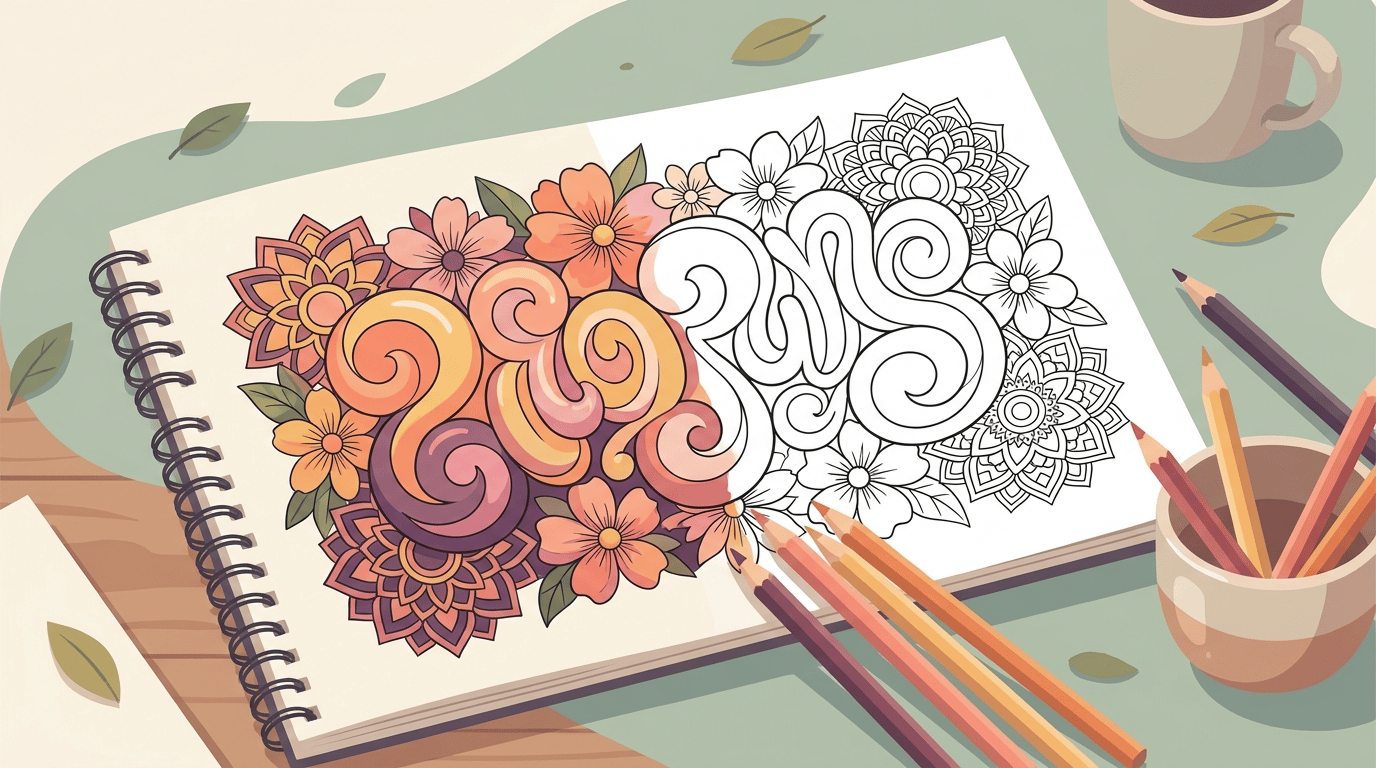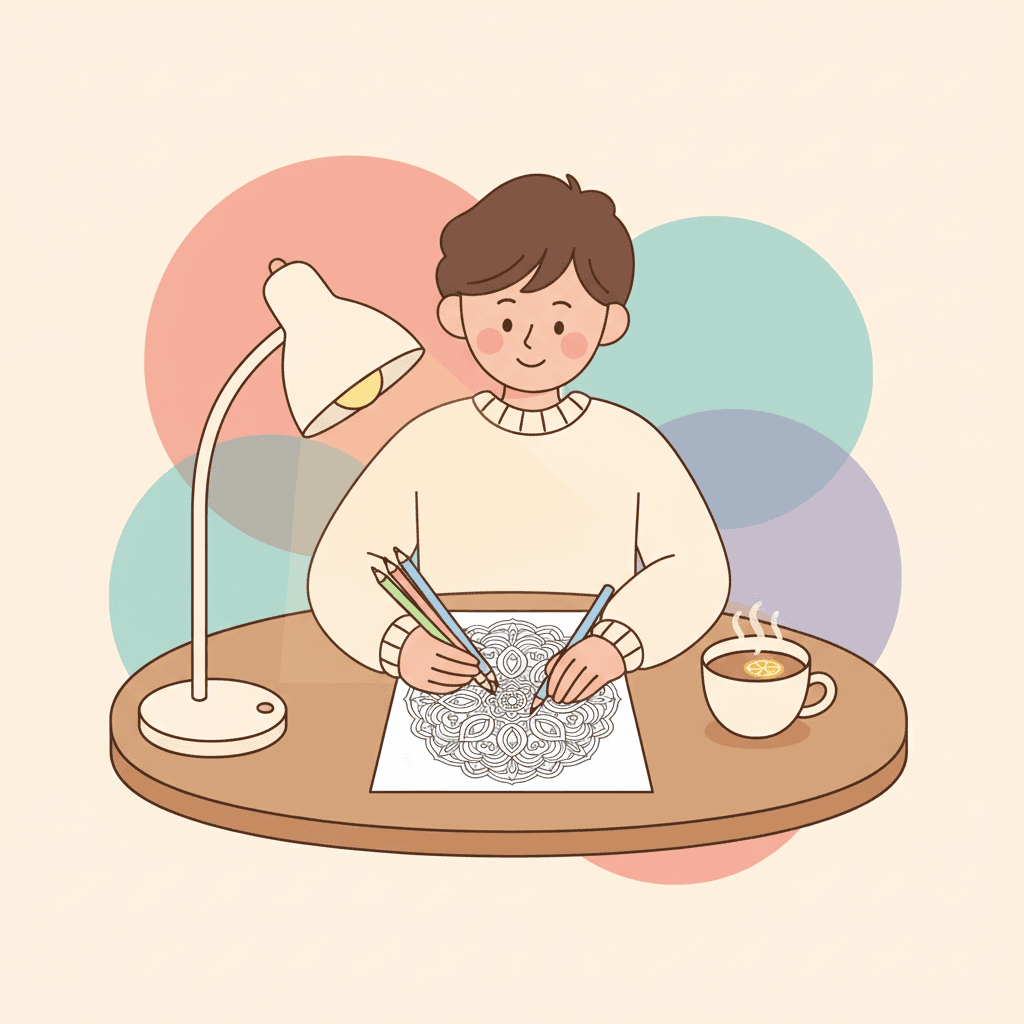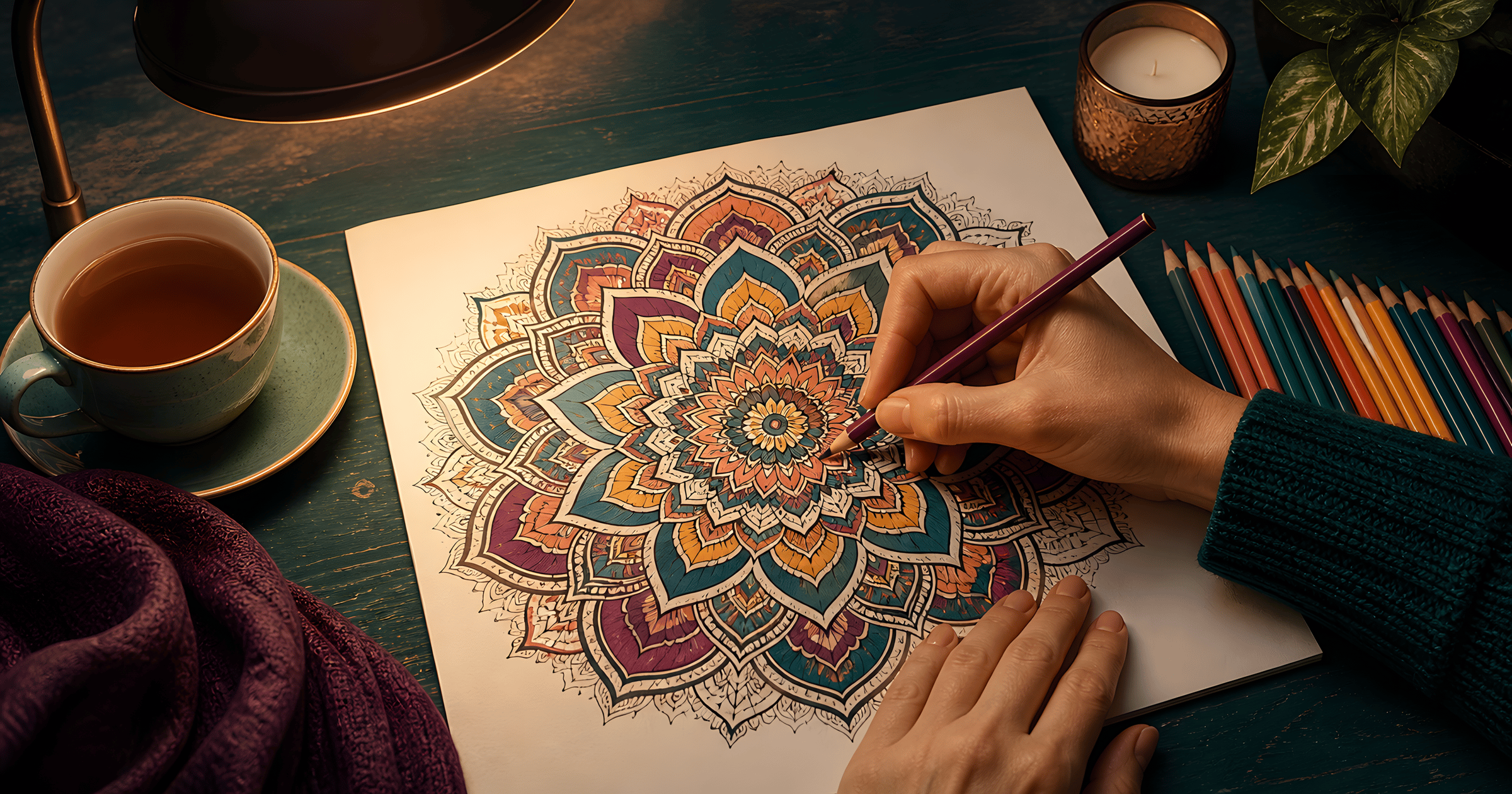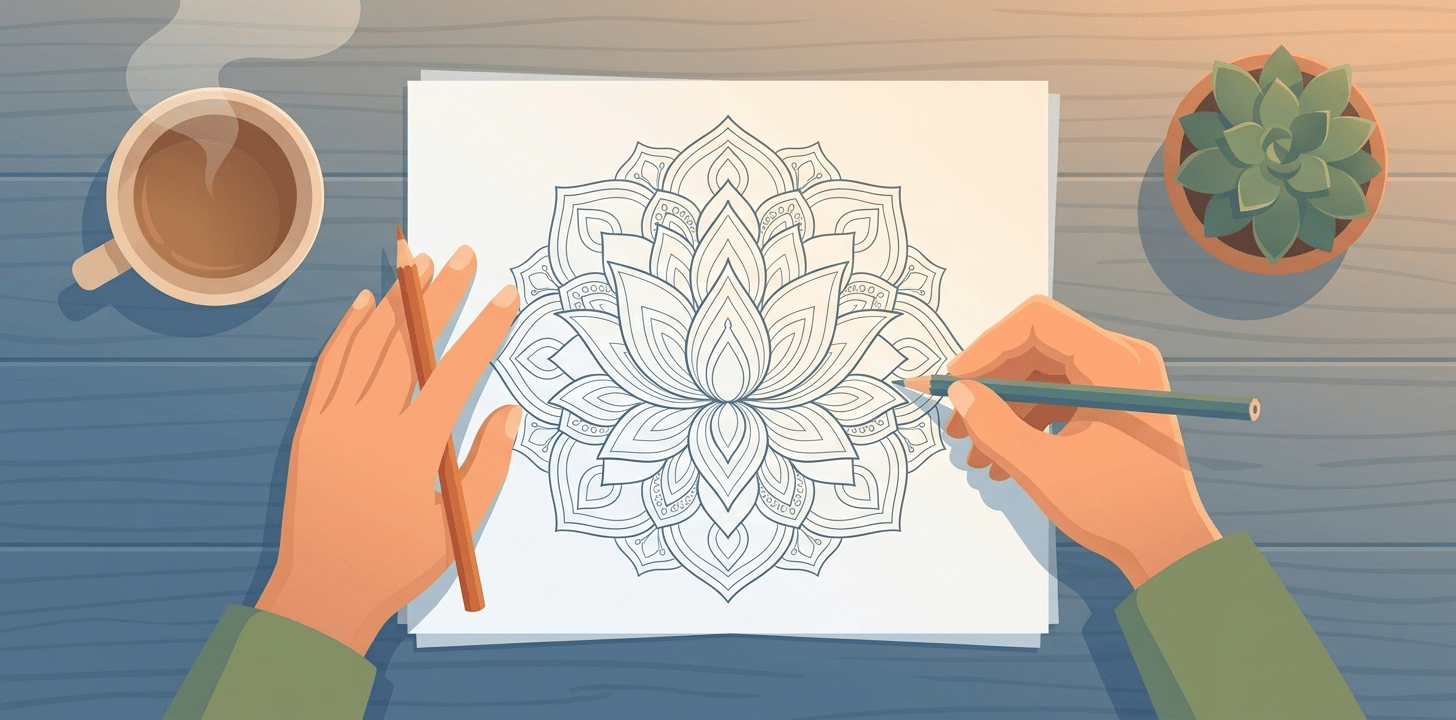
Sitting meditation never worked for me. Not once, not really, across two pretty half-hearted years of trying. Eyes closed, and my grocery list just gets louder somehow. Give my hands a mandala to fill in instead, though, and something in my head goes quiet within about four minutes flat.
Turns out that's not just me. There's actual research behind it, modest but real, and we'll get into that further down. First though, worth sorting out what actually makes a page "mindful" instead of just a page you happen to be coloring while your brain runs off somewhere else entirely.
What makes a page mindful (and what doesn't)
Three things tend to separate the pages that work from the ones that don't.
Repetition's the big one. Petals, scales, tiles, waves, whatever shape repeats often enough that your hands settle into a rhythm without you consciously deciding to. Rhythm is what actually quiets the narrating voice in your skull, not the picture underneath it.
No focal point matters too. A mandala has no single "important" section you can ruin by going outside a line. Compare that to a portrait, where the eyes basically loom over the whole session and some part of you is bracing the entire time.
And then region size, which almost nobody talks about. Too small and you're back in precision-stress territory. Too big and you're bored by minute six, staring at a wall of blue with nothing left to notice.
A few classics from our adult coloring pages collection, all free to print or color right in the browser:
- The lotus mandala is the obvious starting point. Work it from the center outward and let the petals repeat themselves.
- Zen garden. The raked-sand lines practically force slow, even strokes, hard to rush even on purpose.
- Koi pond hides the repetition inside an actual scene, scales and ripples doing the work so it doesn't feel like "doing a pattern" at all.
- Stained glass window, if a built-in palette logic sounds appealing.
Mandalas specifically have close to a century of history behind this, by the way. Jung had patients coloring them back in the early 1900s as a way to settle down, a story we told properly over in the benefits of coloring for adults post.
10 free printable mindfulness coloring pages
These ten pages were made for the kind of coloring described above: repetition without a hundred microscopic spaces, enough structure to stop the decision-making loop, and room to let a pencil move slowly. They are print-first PDF pages, not browser-colorable pages. Open one, download the PDF, and print it at 100%.
1. Lotus mindfulness coloring page for adults

The lotus gives you an obvious center, then the rings of leaves, droplets, and broad arcs take over. Start in the middle and repeat the same three colors outward. It is detailed enough for a full session but orderly enough that you never have to hunt for the next region.
2. Easy mindfulness waves coloring page

This is the low-detail page in the set. Follow one wave band from left to right, then move down to the next. The broad regions suit markers and unhurried pencil strokes, especially on evenings when an intricate mandala would feel like one task too many.
3. Printable mindfulness mandala coloring page

Rounded petals and leaf shapes repeat in clean circular bands, so the palette logic is built in. Pick a color order for the first ring and reuse it around every ring after that. Turning the paper as you go keeps the wrist relaxed and makes the repetition more noticeable.
4. Botanical mindfulness coloring sheet

One vine curls from the center through leaves, berries, flowers, and fern tips. Follow it as a single path rather than hopping around the page. Three greens plus one flower color are enough, and leaving the berries white gives the finished sheet some breathing room.
5. Zen garden meditation coloring page

The raked-sand rings are the anchor here. Trace them slowly around each stone before moving to the bridge, bamboo, stream, and lantern. A limited palette works best: sand, two greens, one wood tone, and a quiet blue if you want the water to stand apart.
6. Full page stress relief mandala coloring page

This is the longest sit in the collection. Broad arches, fan petals, circles, and rounded diamonds fill almost the whole sheet without turning into tiny slivers. Work one repeated shape at a time across the full design instead of completing it ring by ring.
7. Abstract stress relief coloring page for adults

There is no object to color correctly here, which is exactly the appeal. The ribbons, rounded cells, loops, and contour shapes can take any palette without arguing back. Start with the largest curve and let each neighboring region choose the next color for you.
8. Simple stress relief coloring page for adults

Five stacked stones and two eucalyptus stems frame a shallow bowl of water. The regions stay large and the composition stays sparse, so this one fits the ten-minute practice below particularly well. Color the stones as a gradual light-to-dark sequence and stop whenever the timer does.
9. Butterfly stress relief coloring page for adults

Symmetry does the decision-making for you: whatever lands on the left wing gets repeated on the right. The loose leaf wreath gives you a simpler outer rhythm after the patterned wings. Colored pencils handle the smaller wing cells more comfortably than broad markers.
10. Relaxation stress relief coloring page for adults

The moonlit garden is the evening page: hanging stars above, repeated hill contours through the middle, ferns and rounded flowers below. Start with the hill bands if you need an easy rhythm, then move into the smaller botanicals only if the session still feels good.
A ten-minute version, if you want to just try it tonight
This is roughly what I actually do most nights, kitchen table, after the house finally goes quiet. No incense, no app, nothing fancy required.
Setup takes about a minute. One page, three colors, one tool, pencils or markers but not both digging around in a box at the same time. Sixty pencils spread out on the table is a decision treadmill before you've drawn a single line. Three removes the treadmill entirely. Phone goes in another room, not silenced on the table next to you. Another room. Genuinely..
Then arrive, roughly a minute more, though nobody's actually timing to the second. Three slow breaths first. Look at the page like a map, figure out where you're starting. Center-out works well on mandalas since it removes even the "where next" decision before it shows up.
Color slow on purpose for about seven minutes. Half your normal speed, maybe slower. Notice the sound of the pencil against the paper, the little bit of drag under the wax. And that specific moment a region's actually finished, which is oddly satisfying, more than it has any real right to be. You're mind will wander, roughly every forty seconds by my own totally unscientific count. The pattern's your anchor when that happens. Come back back to the stroke you're currently on. That return, over and over, is basically the entire practice. Sitting meditation uses the breath as its anchor. This uses wax on paper, which for a lot of people, me included, is just an easier thing to physically find.
Close it out when the timer goes. Mid-region is fine, don't rush to finish a shape just because time's up. Look at what got colored. You weren't trying to complete anything tonight. You were trying to spend ten minutes a certain way, and that part's already done.
If a guided version helps the first couple times, this session from the Cincinnati library and art museum works as a gentle companion. Press play and color along.
What the research actually says
Real, but modest. Worth being careful about how that gets stated.
Small controlled studies have found that twenty minutes of mandala coloring lowered self-reported anxiety more than free drawing did, and more than reading did too. A 2022 systematic review of coloring studies found small-to-moderate effects on anxiety and mood, fairly consistently across the studies it pulled together. Art therapist Girija Kaimal's research found that ten to twenty minutes of simple creative activity dropped cortisol in alot of the participants she tracked. University mental health programs increasingly treat this as a legitimate self-regulation tool. The University of Iowa's school mental health center publishes coloring sheets right alongside guided breathwork, for exactly this reason.
What it doesn't say matters just as much. Coloring doesn't treat anxiety disorders. Doesn't replace therapy. Doesn't work for everyone, and anyone telling you otherwise is overselling a coloring book pretty hard. It's a reliable way to downshift for twenty minutes, and that's basically the whole claim, which is enough on its own. The fuller research summary lives over in the benefits post, with shorter answers in our FAQs on whether coloring is good for you and what it does in your brain. Weighing something closer to actual therapy? What is coloring therapy draws that line pretty clearly.
Where this usually goes wrong
Picking a page that's too intricate trips people up constantly. Intricate isn't the same thing as mindful, and when the regions demand real precision, attention shifts toward performing the task instead of just noticing it happen. (The whole bold and easy trend exists basically as pushback against this exact mistake.)
Treating a finished page as the actual goal. A finished-page target turns ten quiet minutes into a task with a deadline attached, which undoes a lot of the point before you've even started.
Phone left on the table. One notification undoes about eight minutes of work in maybe four seconds flat. Put it in another room instead. This one's close to non-negotiable, in my experience anyway.
Judging the result while you're still making it. Some of my calmest evenings have produced objectively ugly pages. Colors that don't belong anywhere near each other, lines nowhere close to straight. Nobody's grading these, so let it go.
Forcing it on a restless night rarely works either. Some evenings coloring just doesn't land, and that's fine, honestly. A walk does more good on those particular nights. Swap tools instead of white-knuckling a session that clearly isn't working. More on realistic expectations over in the stress relief pages post.
Kids, classrooms, that kind of thing
Schools lean on this in SEL programs for basically the same reason it works on adults. It's self-regulation that doesn't feel like an exercise, doesn't feel like the feelings chart kids get tired of by October. Shorter sessions help younger kids, maybe five minutes for elementary age, simpler patterns, and naming the skill out loud helps too, something like "we're practicing paying attention to one thing right now." Pairing a page with a short affirmation shows up constantly in classrooms, and that overlapping style has its own full guide over at inspirational coloring sheets.
At home it slots into wind-down time pretty naturally. It's basically the engine behind our preschool bedtime routine and the 10-minute quiet time setup, if you want the fuller versions of either.
Paper or screen
Paper's still the default recommendation for evening sessions. No blue light, more texture to actually notice, and the tactile feedback is part of the anchor itself. But digital is underrated for one specific reason nobody mentions enough.
Undo removes perfectionism. If part of your brain is auditing every single stroke as you make it, knowing any fill is reversible genuinely quiets that auditor down, at least for most people I've talked to about this. Coloring online travels well too, waiting rooms, airports, that kind of dead time, and it saves progress automatically. One mandala can soak up an entire week of scattered ten-minute sessions that way instead of needing one long sitting. Printing instead? Ordinary paper works fine for pencils. The paper guide covers marker-safe options if you're using anything wetter than a colored pencil.
FAQ
What's the difference between mindfulness coloring pages and regular ones?
Design-wise it comes down to repetition, no single focal point, and regions sized to stay moderate. But the bigger difference is actually how you color, not what you're coloring. Slow. Single-tasked. Attention on the current stroke instead of the fifteen still waiting. A dinosaur page colored that way counts as mindful. A mandala colored while half-watching a show really doesn't, no matter how zen it looks in the photo.
How long should a session actually run?
Ten to twenty minutes lines up with what the research tested and what busy people can realistically keep repeating. Longer's fine when it happens naturally. Forcing "longer" as a rule is usually what kills the habit inside of two weeks.
Does this actually help with anxiety?
Small studies keep showing short-term drops in self-reported anxiety after twenty-minute sessions, pretty consistently across different groups. It's a downshift tool. If anxiety's actually interfering with day-to-day life, a coloring page on its own won't cover that, and it works better as a companion to real support than as a substitute for it.
What colors are the most calming?
Weak evidence suggests cooler tones edge out warmer ones slightly, blues and greens mostly. But honestly the repetitive motion matters more than whatever's sitting in the palette. Use whatever colors you actually like looking at. The calm's coming from the rhythm more than anything on the color wheel.
Tonight's version, already picked out for you: the lotus mandala, three colors, ten minutes, phone left in another room. Start at the center.