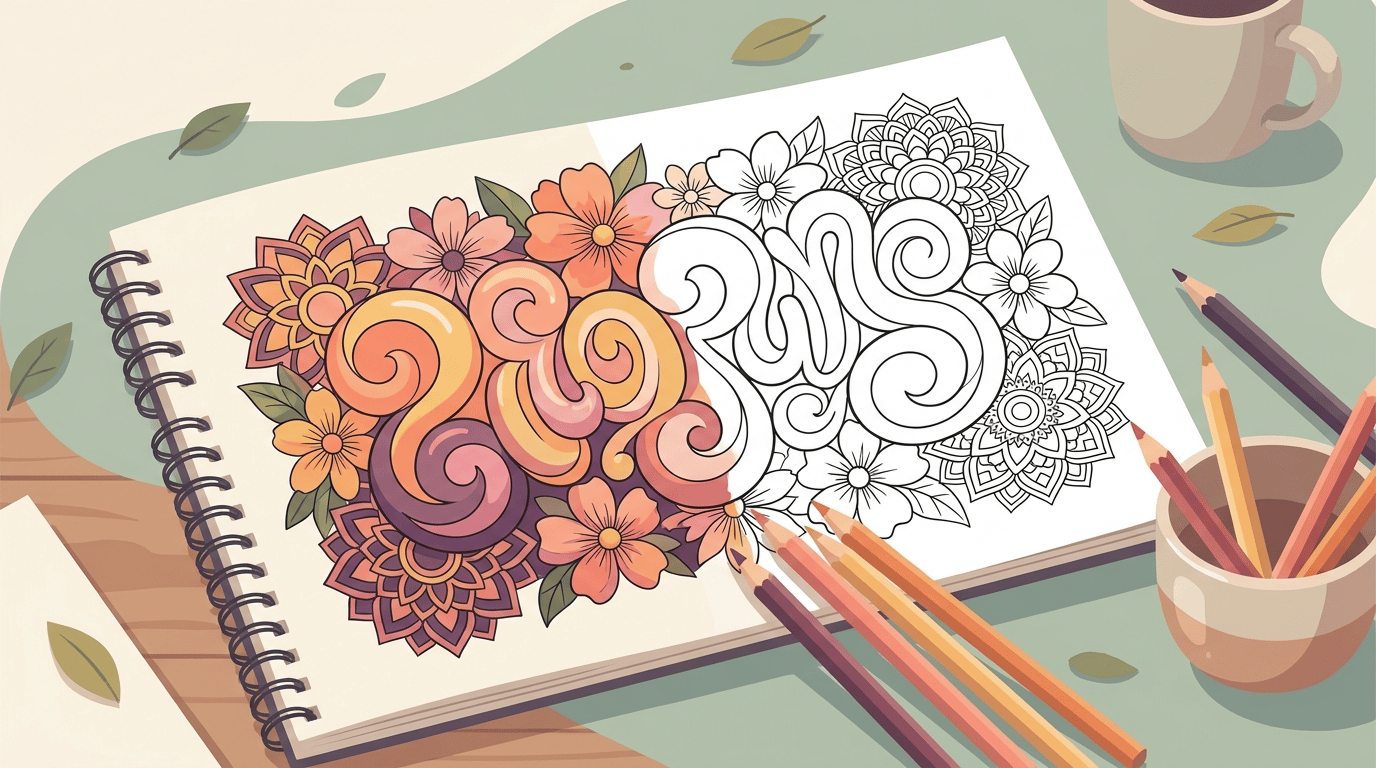
Inspirational coloring sheets are pages built around an uplifting phrase (a quote, an affirmation, a single word like breathe) wrapped in patterns, florals, or mandalas you color around the lettering. They combine two things people already find calming: coloring, and words they want to believe on a rough day.
I was skeptical of these for a long time. A page that says "You've got this" felt like a motivational poster I'd have to color myself. Then I watched my sister-in-law, a middle school counselor, hand them out during finals week and saw thirteen-year-olds, a demographic not famous for sincerity, quietly color "one step at a time" for twenty minutes. Something about filling in a phrase letter by letter makes you sit with it in a way reading never does.
Here's what these sheets are, who actually uses them, and how to color and even make your own.
What counts as an inspirational coloring sheet
The genre covers a few distinct types, and knowing which one you want saves hunting time:
- Quote pages. A full quotation, hand-lettered and surrounded by decoration. Proverbs, famous lines, scripture in the faith-based subgenre.
- Affirmation pages. Short first-person phrases: I am enough. Progress, not perfection. These dominate the classroom and therapy use cases.
- Single-word pages. One word (calm, hope, begin) in large decorative lettering. Fastest to finish and the most striking on a wall.
- Uplifting scenes without text. Sunrises, growing plants, tree-of-life designs. Wordless, but doing the same job.
That last type matters more than it seems. The calm-imagery pages age better on a wall than any slogan, and they're the kind our own library is full of: the tree of life, the lotus mandala, a sunflower field. If the goal is to color something that leaves you better than it found you, text is optional.
Who actually uses these (it's more specific than you'd think)
Teachers and school counselors. Inspirational sheets are a staple of social-emotional learning (SEL) programs: test-week calm-downs, advisory periods, back-to-school stations. Mental health organizations publish free sets specifically for this. The Southeast Kansas Mental Health Center's printable set is a good example of the genre. If you're building a classroom coloring habit generally, our classroom coloring station guide covers the logistics.
Therapists and support groups. Affirmation coloring shows up in anxiety workbooks, grief groups, and recovery programs, where the coloring occupies the hands so the conversation can happen. Related reading: our FAQ on what coloring therapy actually is, because the term gets used loosely.
People building a wind-down habit. Same use case as any adult coloring, with the phrase as a bonus. The evidence for coloring as a calming activity is real if modest. We walked through the studies in benefits of coloring for adults.
Gift-makers. A colored quote page in a $5 frame is a legitimately good small gift. People color a page for a friend's hospital stay, a teacher's last day, a new baby's room.
How to color lettering so it actually looks good
Lettering pages punish the usual approach of starting anywhere and using every color. Three rules make the difference:
- Color the letters last. Do the decorative background first, then choose a letter color that contrasts with what's around it. Letters colored first almost always end up swallowed by the background.
- One color family for the words, one for the decoration. Warm letters on a cool background, or the reverse. That's the whole trick. It's the same contrast principle from our shading guide, applied bluntly.
- Dark letters on a light background, or the exact reverse. Medium-on-medium is how phrases turn invisible. Squint at the page; if the words disappear, add contrast.
Fine-tip tools earn their keep here. The counters of letters (the holes in e and a) are the smallest regions on the page, so colored pencils or fine markers beat crayons. And if you're using markers, put a scrap sheet underneath, because bleed-through ruins the page under it.
If lettering pages frustrate you, that's normal. They're detail work. The wordless route (mandalas, nature scenes) delivers the same calm with less fiddliness, and our mindfulness coloring pages guide leans into exactly that style.
Make your own inspirational sheet (better than it sounds)
Here's the underrated move: the most meaningful inspirational sheet has your phrase on it. The line your grandmother said. The lyric that got you through a bad year. Nobody sells that page, and making it is easy:
- Write or type the phrase big in the middle of a page. Bubble letters or a chunky free font, printed in outline.
- Surround it with doodled patterns: borders, florals, geometric fills. They don't need to be good; they need to be colorable. Closed shapes, decent-sized regions.
- Print copies before coloring, so the original stays blank and you can color it again or hand copies to the whole family.
This is a gateway drug, fair warning. Plenty of people who started making single quote pages ended up producing whole books. If that's you, our guide on how to make a coloring book covers sizes, page counts, and publishing.
Using them well: three small rituals
The sheet is the prop; the ritual is the point.
- Color one page on the first of each month with a phrase for that month. Twelve pages later you have a strange, lovely record of the year.
- The test-week table. Teachers: a stack of affirmation pages and a cup of pencils on a side table, no announcement. They disappear.
- Color it, frame it, give it away. Spending forty-five minutes on a page for someone specific is the actual gift.
One honest caveat, the same one we give in every wellness-adjacent post: an inspirational sheet is a nice twenty minutes, not a treatment plan. If the phrase on the page is carrying more weight than that, the page isn't the right tool. We keep our claims about coloring modest on purpose, and the FAQ on whether coloring is good for you has the fair summary.
FAQ
Where can I find free inspirational coloring sheets?
Mental-health and education organizations publish free sets (the SEKMHC PDF linked above is one), and searching "affirmation coloring pages" with your school district or library name often surfaces local sets. For wordless uplifting pages, our adult coloring pages are free to print or color online.
Are inspirational coloring sheets religious?
Some are. Scripture coloring is a large subgenre. But most are secular affirmations. Read the phrase before printing thirty copies for a public classroom; it saves awkward emails.
What's the best paper and tool for quote pages?
Standard paper is fine for pencils. Use cardstock or marker paper for markers so the frame-worthy page survives. Details in our paper guide. Colored pencils are the safest tool for lettering because of the small regions.
Do these work for kids?
Affirmation pages work well from about age 8, when kids can read the phrase and mean it. Younger kids do better with cheerful scenes than sentences. The easy pages are the right shelf for them.
Pick a phrase that's earned a spot on your wall, or start wordless: the tree of life is twenty calm minutes, free, right now.